RD Calculator
Calculate exactly how much your recurring deposit will return at maturity
Enter your RD details to see maturity amount
We'll calculate interest, tax impact, year-by-year growth, and rate comparisons.
Every month, millions of salaried Indians transfer a fixed amount to a recurring deposit without knowing exactly how much they will receive at maturity. The monthly deposit, the interest rate, and the tenure are all known, but the final number involves quarterly compounding on each instalment separately, which makes manual calculation genuinely complex. This calculator does that work instantly — enter your monthly amount, tenure, and interest rate to get the maturity amount, interest earned, TDS impact, and a year-by-year view of how your money grows.
Banks across India — from SBI and HDFC to ICICI and Axis — offer recurring deposits, and so does the Post Office at 6.7% per annum. Most people open one at their branch and trust whatever number the relationship manager shows them. This calculator lets you verify that number yourself before signing, and shows you how much a change of even half a percent in the interest rate actually affects what you take home at the end.
Why This Calculator Shows More Than a Basic RD Result
Most recurring deposit calculators online take three inputs and show one number. This one shows you the complete picture: gross maturity, net maturity after TDS, interest earned, effective return rate, year-by-year balance growth, and how your outcome changes if the bank offers you a different interest rate. Here is what sets it apart.
Correct quarterly compounding per instalment
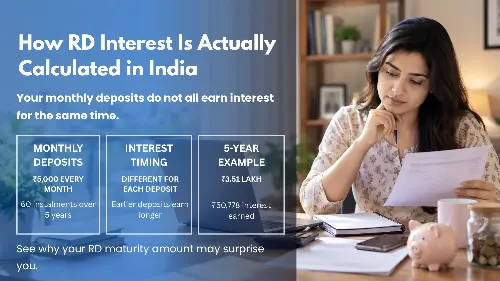
In India, RD interest is compounded quarterly on each instalment separately. The first deposit earns interest for the full tenure, the second for one month less, and so on. This calculator applies that exact formula, not a simplified approximation. The result matches what SBI, HDFC, and Post Office show on their own calculators.
TDS deduction shown separately
Banks deduct TDS at 10% if your annual RD interest crosses ₹40,000 (₹50,000 for senior citizens). The calculator shows you gross maturity, TDS amount, and net maturity in one view, so you know what actually lands in your account, not just what the headline number promises.
Rate comparison across five interest rates
Banks negotiate RD interest rates, and a 0.5% difference on a 5-year RD of ₹5,000 per month changes your maturity amount by over ₹4,000. The comparison tab shows you exactly how much each rate change is worth in rupees, so you know whether a bank's slightly higher offer is actually meaningful.
Year-by-year breakdown table
The yearly table shows cumulative deposit, interest accrued, and running balance for each year of your RD. This is particularly useful for long-tenure RDs of 3 to 10 years, where you can see exactly when your interest earned crosses meaningful thresholds and track progress against your savings goal.
What this calculator does not handle: penalty calculations for missed instalments, premature withdrawal penalty (typically 1% to 2% of principal at most banks), or variations in bank-specific rules for the first instalment. It also assumes a constant interest rate throughout the tenure, which is standard for RDs since the rate is locked at the time of opening. For lump sum investments, use our FD Calculator. For monthly SIP in mutual funds, use our SIP Calculator.
The RD Calculation Formula India Banks Use
RD maturity calculation is more involved than FD because each monthly instalment earns interest for a different number of months. The formula treats each deposit as a separate mini fixed deposit that compounds quarterly for its remaining period. Banks across India, from SBI to the Post Office, use this same method.
M = R × [(1 + i)^n − 1] ÷ [1 − (1 + i)^(−1/3)]
- M = Maturity amount (total value at end of tenure)
- R = Monthly instalment amount in rupees
- i = Quarterly interest rate = Annual rate ÷ 400
- n = Number of quarters in the tenure
This formula assumes quarterly compounding, which is the Indian banking standard for recurring deposits. An alternative approach is the instalment-sum method: sum each monthly deposit compounded for its remaining period. Both approaches give nearly identical results and match bank statements within a few rupees.
Monthly ₹5,000 × 24 months = ₹1,20,000 deposited → Maturity ≈ ₹1,29,020 → Interest earned ≈ ₹9,020
At 7.5% (a common senior citizen rate at SBI or HDFC), the same RD earns about ₹9,680 in interest, roughly ₹660 more on the same deposit. Over a 5-year RD of ₹10,000 per month, that half-percent difference grows to over ₹9,000. This is why comparing rates before opening an RD matters.
Current RD Interest Rates at Major Banks in India (2026)
RD interest rates vary by bank, tenure, and whether you are a regular or senior citizen depositor. Most banks offer 0.25% to 0.50% extra to senior citizens on recurring deposits. The table below shows the approximate ranges for popular banks as of early 2026. Use these as reference when running your own calculation to see whether your bank's offer is competitive.
| Bank / Institution | Regular Citizen Rate | Senior Citizen Rate | Minimum Monthly Deposit | Tenure Range |
|---|---|---|---|---|
| SBI (State Bank of India) | 6.25% – 6.75% p.a. | 6.75% – 7.25% p.a. | ₹100 | 12 – 120 months |
| HDFC Bank | 6.50% – 7.00% p.a. | 7.00% – 7.50% p.a. | ₹1,000 | 6 – 120 months |
| ICICI Bank | 6.25% – 7.00% p.a. | 6.75% – 7.50% p.a. | ₹500 | 6 – 120 months |
| Axis Bank | 6.25% – 7.00% p.a. | 6.75% – 7.75% p.a. | ₹500 | 6 – 120 months |
| Post Office RD | 6.70% p.a. | 6.70% p.a. | ₹100 | 60 months (fixed) |
Interest rates are indicative and change periodically based on RBI policy and individual bank decisions. Always verify the current rate directly with your bank or on their official website before opening an RD account. Senior citizen rates shown are approximate and may include additional bank-specific premiums.
TDS on Recurring Deposits: What the Bank Deducts and How to Avoid It
Tax deducted at source on RD interest is one of the most misunderstood aspects of recurring deposits in India. Many people see their maturity amount is lower than expected and assume the bank made an error. In most cases, TDS has been applied. Here is how it actually works.
When does TDS apply on RD?
Banks deduct TDS at 10% on your total interest income from all RDs and FDs held with that bank if the combined interest crosses ₹40,000 in a financial year. For senior citizens, the threshold is ₹50,000. If you have not submitted your PAN card details to the bank, TDS is deducted at 20% regardless of the interest amount. The bank issues a Form 26AS entry for the TDS deducted, which you can use when filing your income tax return.
How to avoid TDS with Form 15G and 15H
If your total income for the year is below the basic exemption limit, you can submit Form 15G (for individuals below 60 years) or Form 15H (for senior citizens aged 60 and above) to your bank at the start of each financial year. This instructs the bank not to deduct TDS. The form is a self-declaration and has to be submitted afresh every year. Submitting it does not exempt you from paying tax on the interest; it only prevents upfront deduction. You still need to declare the RD interest income under "Income from Other Sources" in your ITR.
Is RD interest taxable even without TDS?
Yes. Whether or not TDS is deducted, all interest earned on a recurring deposit is fully taxable at your applicable income tax slab rate. This is one of the key differences between RD and instruments like PPF or ELSS, where returns are either exempt or partially deductible. If you are in the 30% tax bracket, your effective post-tax return from a 7% RD is approximately 4.9%, which is worth comparing against other post-tax alternatives before committing to a long tenure.
RD vs FD vs SIP: Which Suits Your Savings Goal?
When deciding where to put monthly savings, most Indians compare recurring deposits with fixed deposits and SIP in mutual funds. All three serve different purposes and carry different risk-return profiles. The choice depends on your time horizon, risk appetite, and whether you need guaranteed returns or are willing to accept market-linked outcomes.
Best for: Short to medium-term goals of 1 to 5 years where capital preservation matters. A salaried person saving for a car down payment, home renovation, or a known expense 2 years away benefits most from an RD because the return is guaranteed and the discipline of a fixed monthly deduction is built in.
Current rates at major banks: 6.25% to 7.00% p.a. for regular citizens. Senior citizens typically earn 0.25% to 0.50% more. Interest is taxable at your slab rate.
Limitation: Cannot be withdrawn before maturity without a penalty of 1% to 2%. Returns are fully taxable, which reduces effective yield for those in higher tax brackets.
Best for: Long-term goals of 5 years or more where inflation-beating returns matter. A monthly SIP of ₹5,000 in a diversified equity fund has historically returned 10% to 14% CAGR over 10-year periods in India, significantly outperforming RD rates after accounting for inflation.
Returns are not guaranteed. In a bad year the value of your SIP portfolio can fall 20% to 30%. But over 10 or more years, equity SIPs have consistently beaten every guaranteed return instrument in India.
Limitation: No capital guarantee. Requires comfort with short-term volatility and a longer investment horizon to smooth out market cycles.
The practical answer for most Indian households is not either-or. An RD works well for a goal that is 2 to 3 years away, like a vehicle purchase or a child's school admission fees. A SIP works better for wealth creation over 7 to 15 years, like retirement savings or a child's higher education 12 years from now. To see both numbers side by side, run the SIP projection using our SIP Calculator and compare it against the maturity figure you just calculated here.
How ₹5,000 Per Month Grows at Different Rates and Tenures
The table below shows the maturity amount for a recurring deposit of ₹5,000 per month at various interest rates and tenures, assuming quarterly compounding and no TDS. Use it to benchmark what the calculator shows, or to decide between a shorter and longer tenure before speaking to your bank.
| Tenure | Total Deposited | At 6.5% p.a. | At 7.0% p.a. | At 7.5% p.a. | Interest at 7% |
|---|---|---|---|---|---|
| 1 Year (12 months) | ₹60,000 | ₹62,140 | ₹62,230 | ₹62,320 | ₹2,230 |
| 2 Years (24 months) | ₹1,20,000 | ₹1,28,470 | ₹1,28,910 | ₹1,29,350 | ₹8,910 |
| 3 Years (36 months) | ₹1,80,000 | ₹1,99,430 | ₹2,00,630 | ₹2,01,840 | ₹20,630 |
| 5 Years (60 months) | ₹3,00,000 | ₹3,54,280 | ₹3,57,650 | ₹3,61,080 | ₹57,650 |
| 10 Years (120 months) | ₹6,00,000 | ₹8,44,000 | ₹8,60,730 | ₹8,77,780 | ₹2,60,730 |
The figures above are calculated using the standard quarterly compounding RD formula and are approximate. Your actual maturity amount may differ slightly depending on your bank's internal compounding calendar, how it handles the first instalment, and whether any premature penalty applies. Always verify the final figure on your bank's own calculator or with a branch representative before opening the account.
Post Office RD vs Bank RD: Key Differences
The Post Office Recurring Deposit is one of the most widely opened savings schemes in India, particularly in smaller towns and rural areas where Post Office branches are more accessible than bank branches. It is administered by India Post under the National Savings scheme and backed by the Government of India. Here is how it compares to a bank RD in practical terms.
Interest rate and compounding
The Post Office RD currently offers 6.70% per annum as of Q1 2026 for both regular and senior citizen depositors, compounded quarterly. Unlike bank RDs where rates vary by tenure and are updated independently, the Post Office RD rate is set by the Government of India each quarter and applies uniformly regardless of tenure. The fixed 5-year tenure means there is no choice of duration the way bank RDs allow from 6 months to 10 years.
Minimum deposit and accessibility
The Post Office RD can be opened with as little as ₹100 per month, which is the lowest entry point of any institutional recurring deposit in India. There is no upper limit on the monthly deposit. This makes it accessible to small savers, domestic workers, and daily wage earners who want a disciplined savings habit without needing a bank account. The account can be linked to a Post Office Savings Account for automatic monthly deductions.
Loan against Post Office RD
After completing 12 instalments, you can take a loan of up to 50% of the balance in your Post Office RD. The loan interest rate is 2% above the prevailing RD rate. This liquidity option is available at bank RDs too — most banks allow loans up to 85% to 90% of the RD value at an interest rate 1% to 2% above the deposit rate — but very few people know about it until they need emergency funds and are considering premature closure.
Frequently Asked Questions