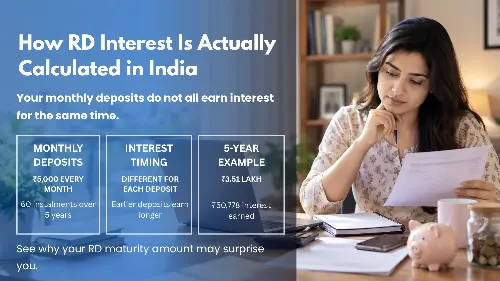
How is RD interest calculated in India? Learn how monthly instalments earn interest for different periods and why your RD maturity amount may surprise you.
You deposit ₹5,000 every month into a recurring deposit and expect the maturity amount to be based on interest earned on the full amount you plan to save.
But when you check the final maturity amount, it may look lower than your calculation.
This usually happens because an RD is not one lump-sum investment. You deposit money every month, so every instalment gets a different amount of time to earn interest. The first instalment earns for the longest period, while the last instalment earns for the shortest.
How RD Interest Works
The easiest way to understand RD interest is to look at how the money enters the account.
Suppose you deposit ₹5,000 every month. Your first ₹5,000 enters the RD first. The next ₹5,000 enters one month later, followed by another ₹5,000 the next month.
These deposits therefore cannot all earn interest for the same period.
Your first instalment gets the longest earning period, while deposits made later get less time to earn interest. This is why you cannot calculate an RD by taking the total amount deposited and applying the annual interest rate to it for the entire tenure.
RD interest is generally calculated using quarterly compounding, while deposits are made every month.
The RD Interest Calculation Formula
The standard RD maturity formula is:
M = R × [(1 + i)n − 1] ÷ [1 − (1 + i)−1/3]
Where:
- M = maturity amount
- R = monthly deposit
- i = quarterly interest rate
- n = number of quarters in the tenure
The quarterly rate is calculated from the annual interest rate. The formula accounts for the different periods for which the monthly deposits remain invested.
You do not need to calculate each instalment manually. Enter your monthly deposit, tenure and rate into the RD Calculator to estimate the maturity amount and interest.
RD Interest Calculation Example
Consider a five-year RD with a monthly deposit of ₹5,000. For this example, we use SBI's 5-year rate of 6.05% p.a. for the general public, as shown on its official retail term deposit rate page.
| Detail | Value |
|---|---|
| Monthly deposit | ₹5,000 |
| Tenure | 5 years |
| Number of months | 60 |
| Interest rate | 6.05% p.a. |
| Total deposited | ₹3,00,000 |
| Maturity amount | ₹3,50,778 |
| Interest earned | ₹50,778 |
So, you deposit ₹3 lakh over five years and receive approximately ₹3.51 lakh at maturity in this example.
Why Your RD Maturity Amount Looks Lower
The most common mistake is to assume that the entire ₹3,00,000 earns interest for five years.
It does not.
Your first ₹5,000 enters the account at the beginning. Your second ₹5,000 arrives one month later, the third arrives another month later, and this continues until the 60th instalment.
As a result, the first instalment earns interest for much longer than the final instalment.
This timing difference is the main reason an RD maturity amount can be lower than a simple calculation based on the total amount you plan to deposit.
Why an FD Can Show a Higher Amount
This is also why an RD should not be compared with an FD simply by looking at the interest rate.
Suppose you have ₹3,00,000 available today and put the full amount into an FD at 6.05% for five years. The complete ₹3,00,000 starts earning interest immediately.
With the RD, you reach ₹3,00,000 only after making monthly deposits over five years. The later deposits therefore have much less time to earn interest.
Using the same 6.05% rate and quarterly compounding, a ₹3,00,000 lump-sum FD for five years would grow to about ₹4,05,053, compared with about ₹3,50,778 in the RD example.
This article focuses on RD interest calculation. For a wider comparison of fixed deposits and market-linked monthly investing, see our SIP vs FD comparison.
Does the Monthly Deposit Change the Calculation?
Yes. A higher monthly deposit increases the total amount you contribute and can increase the interest earned.
For example, depositing ₹10,000 instead of ₹5,000 each month puts more money into the RD every month. However, the calculation principle remains the same.
The first instalment still earns for the longest period, while later instalments earn for shorter periods.
So, whether your monthly RD deposit is ₹1,000 or ₹10,000, you should not calculate interest as if the complete final deposit amount was invested on the first day.
How Tenure Affects RD Interest
A longer tenure means more monthly deposits and more time for the earlier instalments to earn interest.
However, later deposits still enter the account gradually. They do not start earning from the date the RD is opened.
When comparing different RD tenures, look at the total amount deposited, maturity amount and interest earned instead of looking only at the interest rate.
Can TDS Reduce the Amount You Receive?
Tax deducted at source, or TDS, can also affect the amount you finally receive when the applicable interest threshold is crossed.
Deposit-interest TDS rules include a 10% rate once the relevant threshold is crossed, with different thresholds applicable to senior citizens. You can check the applicable conditions in this TDS on deposit interest guide.
Tax rules can change, so check the latest information with the Income Tax Department before making a tax-related decision.
Also, TDS and your final income-tax liability are not necessarily the same thing. Your overall tax position depends on your income and the applicable rules.
What to Check Before Opening an RD
Before opening an RD, check the monthly deposit you can comfortably maintain, the tenure, the applicable interest rate and the conditions for premature closure.
Most importantly, check the rate available when you actually open the account. An example using an older rate may not match your bank's current offer.
Once you know these details, use the RD Calculator to estimate your maturity amount instead of relying on a simple manual calculation.
Frequently Asked Questions
Why is my RD maturity amount lower than expected?
Because your entire planned deposit does not earn interest from the first day. You deposit money every month, so earlier instalments earn for longer and later instalments earn for less time.
Is RD interest compounded quarterly?
RD interest is generally calculated using quarterly compounding in India. The deposits themselves are made monthly.
Does an FD earn more than an RD at the same rate?
For the same eventual total and rate, an FD generally earns more because the full lump sum is invested from the beginning. An RD builds the amount gradually.
Can TDS apply to RD interest?
Yes. TDS can apply when the applicable deposit-interest threshold is crossed. The threshold and conditions depend on the current tax rules and depositor category.
How can I calculate my RD maturity amount?
Enter your monthly deposit, tenure and interest rate into the RD Calculator to estimate the maturity amount and interest.
Calculate Your RD Before You Start
The key point is simple: an RD is a series of monthly deposits, not one large investment.
Your first instalment gets the longest time to earn interest, while your last instalment gets the shortest. This timing is built into the RD calculation formula and explains why the maturity amount may look different from a basic interest calculation.