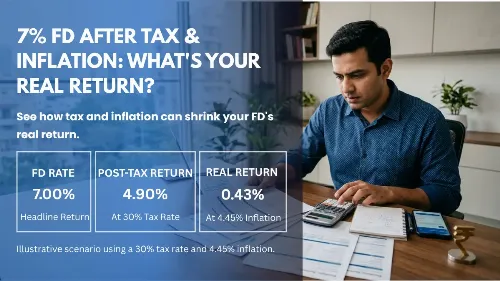
A 7% FD sounds solid, until tax and inflation take their share. See the real, post-tax, post-inflation return across three income slabs.
A 7% FD does not necessarily give you a 7% return in real terms. If the interest falls into a 30% marginal tax-rate scenario, the 7% return becomes 4.90% after tax. With India's latest CPI inflation of 4.45% for July 2026, that works out to a real return of only about 0.43% using the Fisher equation. [Income Tax Department] [MoSPI]
That does not mean every FD investor will earn exactly 0.43%. Your actual result depends on your applicable tax regime, total taxable income and the inflation rate during the period. The 5%, 20% and 30% rates used in this article are illustrative tax-rate scenarios, while the 7% FD rate is an illustrative assumption.
So what is really left from a 7% FD after the taxman takes a share and inflation reduces purchasing power? The calculations below show the post-tax and inflation-adjusted return across three different tax-rate scenarios.
Step 1: How FD Interest Is Actually Taxed in India
FD interest is generally taxable as income and forms part of your overall taxable income. The rate you ultimately pay depends on your applicable tax regime, total taxable income and other provisions that apply to you. The Income Tax Department also lists interest from fixed deposits among the sources of interest income that taxpayers may need to report. [Income Tax Department]
TDS is different from your final tax liability. A bank may deduct TDS on eligible interest payments when the applicable threshold is crossed, but the amount deducted is credited against your overall tax liability. Your final tax position is determined based on your complete income and applicable tax provisions when you file your return. [Income Tax Department]
To isolate the effect of tax on a 7% FD, the table below uses three illustrative marginal tax-rate scenarios: 5%, 20% and 30%. These are simplified examples, not a calculation of the final tax payable by every FD investor.
| Illustrative Tax Rate | FD Rate | Tax Cost on Interest | Post-Tax Return |
|---|---|---|---|
| 5% | 7.00% | 0.35% | 6.65% |
| 20% | 7.00% | 1.40% | 5.60% |
| 30% | 7.00% | 2.10% | 4.90% |
For example, under the simplified 30% scenario, a 7% FD loses 2.10 percentage points of its headline return to the assumed tax cost, leaving a post-tax return of 4.90%. That 4.90% is the number we need before we can measure what inflation does to the FD's real return.
The important point is that the 7% shown by the bank is a pre-tax return. What matters for the next step is the return that remains after considering your tax situation.
Step 2: Applying Inflation With the Fisher Equation
After tax, the next question is how much of that return is left after accounting for inflation. This is where the Fisher equation helps. The real return is calculated as: (1 + post-tax return) ÷ (1 + inflation rate) − 1. This is more precise than simply subtracting inflation from the post-tax return.
India's latest available CPI inflation was 4.45% in July 2026, according to the Ministry of Statistics and Programme Implementation (MoSPI). [MoSPI] Using that figure, here is what each of the three post-tax returns from Step 1 looks like after inflation.
| Illustrative Tax Rate | Post-Tax Return | Real Return at 4.45% Inflation |
|---|---|---|
| 5% | 6.65% | 2.11% |
| 20% | 5.60% | 1.10% |
| 30% | 4.90% | 0.43% |
At 4.45% inflation, all three illustrative scenarios still produce a positive real return. But the margin becomes very small at the higher tax rate. Under the 30% scenario, the 7% FD leaves a post-tax return of 4.90%, which translates into a real return of only 0.43% after inflation.
What Happens if Inflation Rises to 6%?
Current inflation can change significantly over time, so it is useful to test what happens if inflation rises to 6%. This is a hypothetical scenario designed to show how quickly a thin real return can disappear; it is not a forecast of future inflation.
Applying the same three post-tax returns to a 6% inflation scenario gives a very different picture.
| Illustrative Tax Rate | Post-Tax Return | Real Return at 6% Inflation |
|---|---|---|
| 5% | 6.65% | 0.61% |
| 20% | 5.60% | −0.38% |
| 30% | 4.90% | −1.04% |
At 6% inflation, the 20% and 30% illustrative tax scenarios turn negative. A negative real return does not mean the rupee amount in your FD falls. Your account balance can continue to increase while the purchasing power of that money declines because prices are rising faster than your post-tax return.
What a Thin or Negative Real Return Actually Means
A positive real return means your money is growing slightly faster than the general price level after accounting for the assumed tax cost. A negative real return means the opposite: the money may be earning interest in nominal terms, but its purchasing power is falling after tax and inflation are taken into account.
For someone in the higher illustrative tax scenario, a 7% FD therefore does far less inflation-adjusted growing than the headline interest rate suggests. At 4.45% inflation, the real return is only 0.43%; if inflation were to rise to 6%, the same scenario would produce a negative real return of 1.04%.
This is why looking only at the FD's headline interest rate can give an incomplete picture. To understand what your FD is actually doing for your money, you need to consider both the tax you pay on the interest and the purchasing power lost to inflation.
FDs Are Not Useless, But They Are Not Primarily a Growth Tool
None of this means that FDs are a poor product or a mistake to hold. They offer predictable returns, relatively low risk and easy access to money, which can make them useful when protecting your principal matters more than maximizing growth.
The point is more specific: an FD is generally better suited to capital preservation and short- to medium-term financial goals than to doing the heavy lifting for long-term wealth creation. Whether an FD actually beats inflation after tax depends on the interest rate, your tax situation and the inflation rate during the investment period.
FDs can make sense in several situations, such as keeping part of an emergency fund, saving for a relatively near-term goal, taking advantage of higher rates that some banks offer to senior citizens, or maintaining a stable, low-risk portion of a broader portfolio.
At the same time, if your goal is long-term growth that stays ahead of inflation, it is worth comparing the FD's after-tax, inflation-adjusted return with other investments. Equity mutual funds, for example, have a different return potential and a substantially different risk profile. Our SIP returns after inflation article explores how those returns look after accounting for inflation.
There is another side to the same problem: if your income does not grow at least as quickly as the cost of living, your purchasing power can come under pressure even when your savings are earning interest. Our article on salary growth needed to beat inflation looks at that side of the equation.
Frequently Asked Questions
Does a 7% FD always beat inflation?
Not necessarily. After tax, a 7% FD's real return depends heavily on your tax slab and the prevailing inflation rate. At higher tax slabs or higher inflation, the real return can shrink close to zero or turn negative.
Why does my tax rate affect my FD's real return so much?
FD interest is taxable income, so the tax you ultimately pay on it can reduce the return available to you. In our simplified 30% tax-rate scenario, a 7% FD loses 2.10 percentage points to the assumed tax cost, reducing the post-tax return to 4.90% before inflation is considered. Your actual tax outcome depends on your total taxable income, applicable tax regime and other provisions that apply to you. Senior citizens may have a different tax outcome: under Section 80TTB, an eligible resident senior citizen can claim a deduction of up to ₹50,000 on qualifying deposit interest, including fixed-deposit interest, subject to applicable conditions.
Is it correct to just subtract inflation from my FD's post-tax return?
It is a rough approximation, not the accurate method. The Fisher equation, real rate equals (1 plus post-tax return) divided by (1 plus inflation) minus 1, gives the mathematically correct real return, especially over longer holding periods.
Should I stop investing in FDs because of this?
Not necessarily. FDs remain useful for safety, liquidity, and short-term goals. The point is not to treat an FD as a wealth-growing instrument, since it is not designed or priced to reliably outpace inflation after tax for most investors.
See Your Own FD's Real Return
A 7% FD does not tell the whole story. After accounting for tax and inflation, the return you actually earn in real terms can be much smaller than the headline interest rate suggests.
Your result will depend on your FD rate, tax situation and the inflation rate during the investment period. The examples in this article are illustrative, so the best way to understand your own position is to calculate it using your actual numbers.
Use our free FD Calculator to work out your post-tax FD return, then use the Inflation Impact Calculator to see how much of that return remains after inflation.