₹1 lakh today buys a lot less 15 years from now. See the real math behind inflation impact on savings in India, free and anonymous.
Finally hitting ₹1,00,000 in an emergency fund feels like a real milestone, something solid to fall back on if things go wrong. Then someone, maybe an uncle who reads the business page, or a colleague who just finished an MBA, casually mentions that the same ₹1,00,000 will not buy in 15 years what it buys today. Not because it will be stolen or spent. Because it will quietly be worth less, just sitting there.
That sentence lands harder than it should for something so simple. This article shows exactly how much less, using India's most current inflation data, and why keeping money still is not the same as keeping it safe.
What Purchasing Power Erosion Actually Means
Purchasing power is simply what your money can buy. Inflation is the slow, steady rise in prices over time. Put the two together, and you get purchasing power erosion, the same rupee amount buying less and less as years go by, even though the number in your account never changes.
Your ₹1,00,000 will still say ₹1,00,000 on your passbook in 15 years, to the rupee. What changes is everything around that number. Prices for groceries, rent, school fees, and nearly everything else keep climbing, while your ₹1,00,000 stays exactly where it was.
The Rule of 70, Applied to India
There is a simple way to estimate how fast this happens, called the Rule of 70. Divide 70 by the inflation rate, and you get roughly how many years it takes for money to lose half its purchasing power.
Using India's most recent official inflation figure, the Consumer Price Index for June 2026 released by the Ministry of Statistics and Programme Implementation on July 13, 2026, headline CPI inflation stood at 4.38% year-on-year, as published in the official MoSPI press release on the Press Information Bureau.
Applying the Rule of 70 here: 70 divided by 4.38 comes to almost exactly 16 years. That means at this inflation rate, your ₹1,00,000 loses half its real value in about 16 years, not because anything happens to the money itself, but because everything around it keeps getting more expensive.
What ₹1,00,000 Is Actually Worth, Year by Year
Here is the same ₹1,00,000, its nominal amount never changing, shown against its real purchasing power at 4.38% inflation over time.
| Milestone | Nominal Amount | Real Purchasing Power (Today's Rupees) |
|---|---|---|
| Today | ₹1,00,000 | ₹1,00,000 |
| Year 5 | ₹1,00,000 | ₹80,707 |
| Year 10 | ₹1,00,000 | ₹65,137 |
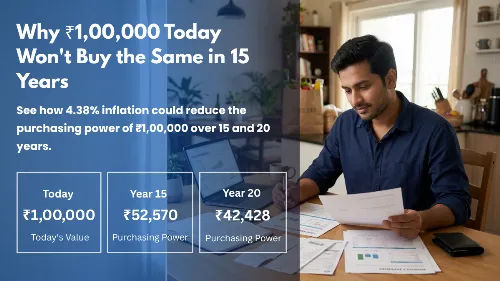
| Year 15 | ₹1,00,000 | ₹52,570 |
| Year 20 | ₹1,00,000 | ₹42,428 |
By year 15, that ₹1,00,000 is worth close to ₹52,570 in today's terms, roughly half its original buying power. By year 20, it has slipped below ₹42,500. The number on the passbook never moved. Everything it could once buy simply got more expensive around it.
Why a Savings Account Makes This Worse, Not Better
Most Indian savings accounts pay interest of roughly 2.5% to 3.5% a year. Against inflation running at 4.38%, that gap means your money is losing real value even while it earns interest, since the interest earned does not keep up with rising prices.
This isn't a flaw in any particular bank. Savings account rates are built for easy access and safety, not for outpacing inflation. Keeping a large sum parked there for years feels careful, but it's quietly one of the more expensive places to leave money for the long term.
For a closer look at how this plays out with fixed deposits specifically, including the added effect of tax, our article on how FDs can lose money after inflation walks through the exact math.
What This Looks Like in Real Life
Numbers on a table are easy to skim past. Here is what the same 4.38% inflation rate does to things you already know the price of today, over 15 years.
A monthly grocery basket that costs a family around ₹8,000 today would cost close to ₹15,200 in 15 years, for the same items in the same quantities. An annual school fee of ₹50,000 today would climb to roughly ₹95,100. Monthly rent of ₹15,000 for a modest flat in a mid-tier city would rise to about ₹28,500.
None of these things are getting more expensive because they changed. The rupee buying them is worth less each year, the same quiet erosion sitting inside your savings account.
What This Means for You
Money that is not growing faster than inflation is shrinking in real terms, even while the number stays the same or even grows slowly. That is the entire idea behind everything in this article.
This does not mean investing is complicated or risky in a way that should scare you away from it. It means the direction matters: money needs to be doing something that outpaces the rate at which prices rise around it, whether that is equity, mutual funds, or another instrument suited to your goals and timeline. If your income itself is not keeping pace with inflation either, our article on salary growth needed to beat inflation covers that side of the same problem.
Frequently Asked Questions
What is the Rule of 70 in simple terms?
It is a quick way to estimate how many years it takes for money to lose half its purchasing power to inflation. Divide 70 by the inflation rate, so at 4.38% inflation, money halves in real value in about 16 years.
Does keeping money in a savings account protect it from inflation?
No. Most Indian savings accounts pay 2.5% to 3.5% interest, below India's current 4.38% inflation rate. This means money in a savings account is actually losing real value every year, even as it earns interest.
What inflation rate does this article use, and where is it from?
This article uses 4.38%, India's official headline CPI inflation for June 2026, published by the Ministry of Statistics and Programme Implementation on July 13, 2026. Inflation rates change month to month and are not guaranteed to stay at this level.
How much will ₹1,00,000 be worth in 15 years?
At the current 4.38% inflation rate, ₹1,00,000 today would have real purchasing power of roughly ₹52,570 in 15 years, close to half its current value, even though the nominal amount stays exactly ₹1,00,000.
See What Your Own Amount Will Really Be Worth
The ₹1,00,000 in your account isn't disappearing. It's buying less with each year it sits still, without a single rupee ever leaving.
Use our free Inflation Impact Calculator to see exactly what any amount of yours, at any time horizon, is really worth once inflation is accounted for.