How RD Interest Is Actually Calculated in India
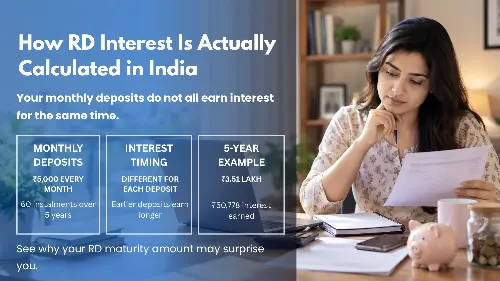
How is RD interest calculated in India? Learn how monthly instalments earn interest for different periods and why your RD maturity amount may surprise you.
Tag
You are reading articles tagged #Personal Finance. These are handpicked guides written for Indian readers — no jargon, no filler, just the information you actually need to make better financial decisions.
How is RD interest calculated in India? Learn how monthly instalments earn interest for different periods and why your RD maturity amount may surprise you.
Saving ₹5,000 a month? Compare RD vs SIP over five years and see the difference between predictable returns and market-linked growth.
A 7% salary raise sounds good, but how much do you really gain after inflation? See India's latest data, salary figures and real-growth examples.
See how a ₹5,000 monthly SIP for 20 years at 12% grows to ₹49.96 lakh but is worth only about ₹23.11 lakh in today's money after inflation.
Compare a flat SIP and a 10% Step-Up SIP over 20 years. See total investment, year-by-year growth, and whether increasing your SIP really pays off.
Most car buyers budget only for the EMI. Discover the hidden monthly costs of owning a car in India, including fuel, insurance, servicing, parking, tolls, and depreciation that can add over ₹8 lakh in 4 years.
Most people do not buy cars because they need them. They buy them because a colleague upgraded, a neighbour bought one, or a dealer made the EMI look manageable. Here's why so many Indians end up with cars they cannot truly afford.
Should you prepay your loan in small monthly amounts or save up for one yearly lump sum? We compare both strategies with a real worked example.
Prepaying the same amount early versus late in your loan tenure produces very different savings. See the real rupee difference with a worked example.
Tags on Fintool Baba are added by hand, not generated automatically. That means when you see #Personal Finance on an article, it's there because the piece genuinely deals with that topic — not because a script matched a keyword. The result is a tighter, more useful reading list than you'd find on most aggregator-style finance sites.
Every article here is written with an Indian context in mind from the first sentence. Figures are in rupees. Examples use Indian banks, Indian cities, and Indian financial products. Tax references follow the Income Tax Act as it currently stands. If something changes — a new budget, a revised interest rate, a rule update from SEBI or RBI — we go back and revise the affected articles rather than leaving outdated information sitting on the page.
If this is your first time on a #Personal Finance page, the article at the top is a good place to start. It's placed there because readers consistently find it the most useful entry point — whether they're completely new to the topic or just looking for a reliable second opinion before making a decision.