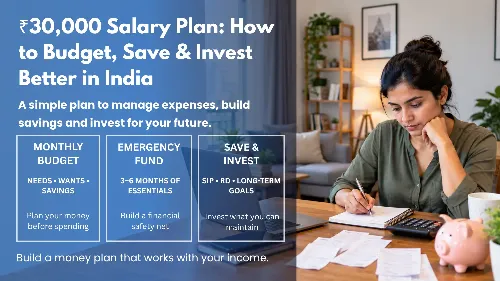
Earning ₹30,000 a month? Learn how to manage expenses, build an emergency fund, save regularly and invest wisely with a simple financial plan in India.
Rent goes out first, then groceries, transport, phone bills and other monthly expenses. By the middle of the month, a ₹30,000 salary can feel much smaller than it looked on payday.
You can still save and invest on this income. The key is to decide where your money should go before you start spending it, instead of waiting until the end of the month to see what is left.
A practical plan should first cover your essential expenses, then build an emergency fund and, after that, put more money toward long-term goals. Your exact numbers will depend on your rent, family situation, existing loans and other monthly expenses.
Check Your Own Numbers: Use our free Expense Planner to get a budget split based on your actual income and housing situation. You can also use our Contingency Fund Tracker to set and track your emergency fund.
What Should a ₹30,000 Salary Budget Look Like?
The popular 50-30-20 rule suggests using 50% of your income for needs, 30% for wants and 20% for savings. It can be a useful starting point, but it does not fit every salary or living situation.
When you earn ₹30,000, rent and other essential expenses can already take more than half of your income. Trying to force your budget into a fixed 50% needs limit may leave you short before the month ends.
FinTool Baba's Expense Planner gives a practical split for a single renter earning between ₹25,000 and ₹35,000. For a ₹30,000 income, the published split works out to:
| Category | Share of Income | Amount |
|---|---|---|
| Needs (rent, groceries, transport, utilities) | 59% | ₹17,700 |
| Wants (dining, entertainment, shopping) | 20% | ₹6,000 |
| Savings (emergency fund, SIP, insurance) | 17% | ₹5,100 |
| Unallocated / extra savings | 4% | ₹1,200 |
The 59% needs allocation is not a fixed rule for everyone. Your rent may be lower in one city and much higher in another. If your essential expenses take more of your salary, you can reduce wants and other flexible spending instead of stopping your savings completely.
How Is the ₹30,000 Budget Split Calculated?
You do not need a complicated calculation to convert a percentage into a monthly amount. Use this simple formula:
For example, to calculate the needs amount:
₹30,000 × 59 ÷ 100 = ₹17,700
The same calculation gives the other amounts:
Wants: ₹30,000 × 20 ÷ 100 = ₹6,000
Savings: ₹30,000 × 17 ÷ 100 = ₹5,100
Unallocated / extra savings: ₹30,000 × 4 ÷ 100 = ₹1,200
You can also check that the complete budget adds up to your salary:
₹17,700 + ₹6,000 + ₹5,100 + ₹1,200 = ₹30,000
And the percentages also add up correctly:
59% + 20% + 17% + 4% = 100%
These numbers are only an example based on the FinTool Baba planner's published split. Your own budget can be different. If your rent is higher, for example, you may need to reduce discretionary spending to keep some amount aside for savings.
Build Your Emergency Fund Before Investing More
Once your monthly essentials are covered, your next priority should be building a financial safety net. An emergency fund gives you money to fall back on when an unexpected expense or income gap appears.
A useful target is around 3 to 6 months of essential expenses. The target should be based on what you actually need to run your household, not simply on your ₹30,000 salary.
For example, if your essential expenses are around ₹18,000 a month, you can calculate the emergency-fund target like this:
For a 3-month fund:
₹18,000 × 3 = ₹54,000
For a 6-month fund:
₹18,000 × 6 = ₹1,08,000
These are examples to show how the calculation works. Your target may be higher or lower depending on your essential expenses and financial responsibilities.
If you are a single earner without dependants, you may start by targeting the lower end. If you have dependants, a home-loan EMI or less stable income, building toward six months can give you a larger safety cushion.
You do not need to build the entire amount immediately. Start with an amount you can manage every month and increase it when your income rises or another regular expense falls.
Use the Contingency Fund Tracker to set your target, enter your existing savings and track how much is still left to build.
Where Should Your Savings Go After the Emergency Fund?
Once you have a basic emergency fund, you can start putting more of your monthly savings toward longer-term goals.
There is no single SIP amount that everyone earning ₹30,000 should invest. Your rent, family expenses, insurance, loans and other commitments all affect how much you can comfortably put aside.
The important thing is to choose an amount that you can continue regularly. A smaller monthly investment that you can maintain is usually more practical than starting with a large amount and stopping after a few months because your budget becomes tight.
You can also divide your long-term savings according to your goals. An SIP is market-linked, while an RD is a fixed-return savings option. The suitable choice depends on your goal, time period and comfort with risk.
You do not need to repeat the full calculation here. Our ₹5,000 RD vs SIP comparison already explains how the two options compare over five years. If you want to understand how RD interest is calculated, see our guide to how RD interest is actually calculated.
For your own monthly amount, use the SIP Calculator and RD Calculator to check the numbers before deciding how much to invest.
What About Tax-Saving Investments?
If you use the old tax regime, NPS can be another tax-saving option to consider.
In simple terms, a tax regime is the tax system used to calculate your income tax. In India, taxpayers can choose between the old tax regime and the new tax regime, subject to the applicable rules.
Under Section 80CCD(1B), eligible NPS contributions can qualify for an additional deduction of up to ₹50,000, over and above the ₹1.5 lakh limit under Section 80C, as explained by ClearTax.
In simple terms, this means an eligible NPS contribution may give you an extra tax deduction if you are using the old tax regime.
Do Not Skip Health Insurance to Increase Your SIP
If your employer already provides health insurance, first check the coverage and who is included in the policy. If you do not have adequate cover, health insurance deserves a place in your budget before increasing your investment amount.
FinTool Baba's budgeting guidance puts a basic family floater with ₹5 lakh to ₹10 lakh coverage at roughly ₹8,000 to ₹20,000 a year, depending on factors such as age and family size. That works out to around ₹700 to ₹1,700 a month.
The actual premium can be different for you. Age, family members, location, coverage and the policy you choose can all affect the cost.
On a ₹30,000 salary, treat this as part of your financial plan instead of adding it after you have already decided how much to invest.
What If You Already Have an EMI?
If you are already paying a personal loan, home-loan EMI or another fixed repayment, include it in your monthly budget before deciding how much you can save.
An EMI is a fixed monthly commitment just like rent. If too much of your salary goes toward EMIs, you may have very little left for emergencies, insurance and regular savings.
Also remember that the amount a lender is willing to approve is not necessarily the amount you should borrow. Your monthly budget should decide what you can comfortably repay.
If you are considering a loan, use our Loan Eligibility Checker to understand your possible eligibility before making a borrowing decision.
Common Money Mistakes on a ₹30,000 Salary
One common mistake is saving whatever is left at the end of the month. On a tight budget, there may be very little left by the 25th.
A better approach is to move your planned savings soon after your salary arrives. You can then manage your discretionary spending with the amount that remains.
Another mistake is copying someone else's budget without considering your own expenses. A person paying ₹7,000 in rent cannot follow exactly the same plan as someone paying ₹13,000.
It is also easy to increase spending every time your salary increases. When you get a raise, consider increasing your emergency savings or investment amount before increasing every discretionary expense.
Finally, do not invest aggressively while ignoring your emergency fund or necessary insurance. Your investments are for future goals, while your emergency fund helps protect you from today's unexpected expenses.
A Simple Payday Plan for ₹30,000
You do not need a complicated system to manage your salary. A simple routine can make the budget easier to follow.
First: Keep aside money for rent, EMIs, groceries, transport and other essential bills.
Second: Transfer your planned savings or emergency-fund amount soon after receiving your salary.
Third: Keep money aside for insurance and other important financial commitments.
Fourth: Use the remaining amount for wants and other flexible spending.
Once your emergency fund is ready, the amount you were putting toward it can gradually be redirected toward your longer-term financial goals.
Frequently Asked Questions
How much should I save from a ₹30,000 salary?
FinTool Baba's Expense Planner shows a 17% savings allocation for a ₹30,000 income in its relevant budgeting bracket, which works out to ₹5,100. The actual amount you can save may be different depending on rent, family expenses, insurance and other commitments.
Can I start investing with a ₹30,000 salary?
Yes. First make sure your essential expenses are covered and start building an emergency fund. Once you have a basic safety buffer, you can use a manageable monthly amount for long-term investments according to your goals and risk comfort.
How much should I spend on wants from a ₹30,000 salary?
The FinTool Baba planner uses 20% for wants in its ₹25,000 to ₹35,000 single-renter bracket, which is ₹6,000 on ₹30,000. If your essential expenses are higher, you can reduce the wants amount rather than completely cutting your savings.
How much emergency fund should I have on a ₹30,000 salary?
Base the target on your essential monthly expenses rather than your salary. For example, if your essential expenses are ₹18,000, a 3-month fund is ₹54,000 and a 6-month fund is ₹1,08,000.
What is the old tax regime?
The old tax regime is one of the tax systems used to calculate income tax in India. It allows certain deductions and exemptions that are not available in the same way under the new tax regime. Check which regime applies to your situation before planning investments for tax benefits.
Should I invest or build an emergency fund first?
Build a basic emergency fund first. Once you have a reasonable safety buffer, you can put more of your monthly savings toward long-term investments based on your financial goals.
Put Your Own Numbers Into the Plan
A ₹30,000 salary does not mean you have to wait for a bigger paycheck before you start managing your money properly. The goal is to create a plan that works with your actual expenses and that you can follow every month.
Start by entering your income, housing situation and expenses into the Expense Planner. Then set your emergency-fund target using the Contingency Fund Tracker.
Once your emergency fund is in place, use the SIP Calculator or RD Calculator to check what your chosen monthly amount could become over time.
The important thing is not to copy someone else's exact budget. Start with your own numbers, make sure your essentials are covered, protect a basic savings amount and then increase your investments as your financial situation improves.