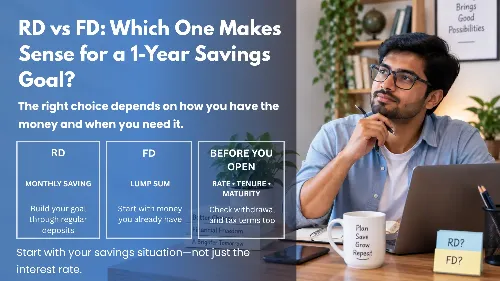
Saving for a goal one year away? Compare RD vs FD based on monthly saving, lump-sum investment, interest, tax and withdrawal terms.
You have a savings goal that is about one year away. Maybe you are planning a purchase, a yearly payment or simply want to keep money aside for a known expense.
The question is whether an RD or FD fits that goal better.
The main thing to look at first is simple: Do you already have the money, or will you save it every month?
An RD is built around regular monthly deposits. An FD starts with a lump sum. Both are deposit products, but they work differently because the money enters the account differently.
RD vs FD: What Is the Difference?
The basic difference is how the money is deposited.
With an RD, you deposit a fixed amount every month for the selected tenure. The instalments enter the account at different times, so they do not all earn interest for the same period.
With an FD, you deposit a lump sum at the beginning. The deposited amount then earns interest according to the applicable rate, tenure and deposit terms.
| Factor | RD | FD |
|---|---|---|
| How you deposit | Monthly instalments | Lump sum |
| Do you need the full amount today? | No | Yes |
| Main use | Regular saving | Investing an existing amount |
| Return linked to stock market? | No | No |
| Interest calculation | Based on monthly instalments | Based on the deposited lump sum |
When an RD Can Fit a 1-Year Savings Goal
An RD can be useful when the money for your goal will come from your monthly income.
You do not need to have the complete target amount sitting in your account today. Instead, you decide how much you can save regularly and put that amount into the RD.
An RD may fit your situation when:
- You receive your income regularly.
- You want to save a fixed amount every month.
- You do not already have the full amount required for the goal.
- You want to keep the money away from market-linked investments for a near-term goal.
- You prefer a fixed saving routine.
The tenure is important, though. A one-year goal does not automatically mean that every RD product will have a one-year tenure. Banks offer different RD periods, so check the available tenure before opening the account.
If you want to understand why RD interest is calculated differently from an FD, see our detailed guide on How RD Interest Is Actually Calculated in India.
When an FD Can Fit a 1-Year Savings Goal
An FD is more relevant when you already have the money available as a lump sum.
Instead of adding money every month, you place the available amount into the FD for the selected tenure. The entire deposited amount starts earning interest according to the applicable FD terms.
An FD may fit your situation when:
- You already have the money saved.
- You know approximately when you will need the money.
- You want a deposit with a more predictable maturity value.
- You do not want the money exposed to stock-market movements.
- You do not need to keep adding money every month.
What If You Are Starting From Zero?
If you are starting without the full amount, an FD may not be the natural fit because an FD requires a lump sum at the time of opening.
An RD is designed for the other situation: you build the savings through regular deposits.
So ask yourself one thing:
Will the money come from a lump sum you already have, or from your monthly income?
If you already have the money, an FD can be compared with other available deposit options.
If you are building the money from your monthly income, an RD can be considered.
This makes the comparison more useful than simply looking at which product displays the higher interest rate.
What About Post Office Rates?
The Government of India reviews small-savings interest rates periodically. The Department of Economic Affairs publishes the relevant notifications and rate revisions for these schemes.
The Post Office also has both Time Deposit and Recurring Deposit products, but they do not have the same structure or tenure.
This is important for a one-year goal because a Post Office Time Deposit can have a one-year option, while the National Savings Recurring Deposit has a longer standard tenure.
Therefore, a Post Office RD should not automatically be treated as a one-year RD simply because the savings goal is one year away.
The latest small-savings notifications can be checked on the official Department of Economic Affairs website.
How Is the Interest Different?
The main reason RD and FD maturity amounts cannot be compared by simply looking at the interest rate is the timing of the deposits.
With an FD, the lump sum is deposited at the start. With an RD, the deposits arrive month by month.
This means the first RD instalment has more time to earn interest than the later instalments.
The exact RD calculation also depends on the applicable rate, tenure and calculation method. It is better to use the actual figures rather than trying to estimate the maturity amount by applying the annual rate to the total amount you expect to deposit.
Our RD Calculator lets you enter the monthly deposit, tenure and interest rate to calculate the maturity amount.
If you already have a lump sum, the FD Calculator can be used instead.
What Should You Check Before Opening an RD or FD?
The interest rate is only one part of the comparison.
Before opening a deposit for a one-year goal, check the following:
- Interest rate applicable to your tenure.
- Actual maturity date.
- Minimum deposit requirements.
- Premature closure rules.
- Interest payable if the deposit is closed early.
- Renewal instructions.
- Tax and TDS implications.
These terms can vary between banks and deposit schemes.
Can You Withdraw the Money Before One Year?
A one-year savings goal does not always mean the money will stay untouched until the exact maturity date.
An unexpected expense may come up, or the goal date may change.
RD and FD products can have rules for premature closure or withdrawal. The interest you receive after closing the deposit early may also differ from what you expected at the time of opening.
The exact conditions depend on the bank or scheme.
For that reason, check the premature-closure rules before opening a deposit if there is a reasonable chance you may need the money earlier.
What About Tax on RD and FD Interest?
Interest earned from deposits can have tax implications.
The amount of tax you finally pay depends on the applicable income-tax rules and your overall tax position. TDS may also apply when the relevant conditions and thresholds are met.
Because tax rules can change, the current rules should be checked before making a tax-related decision.
The official Income Tax Department website provides current information on TDS compliance.
Are RD and FD Covered by Deposit Insurance?
Eligible bank deposits, including fixed deposits and recurring deposits, are covered by the Deposit Insurance and Credit Guarantee Corporation (DICGC), subject to its rules.
The current DICGC insurance limit is up to ₹5 lakh per depositor per bank, including principal and interest, subject to the applicable ownership and account conditions.
The limit is not simply ₹5 lakh for every individual account. Deposits held in the same right and same capacity at the same bank are considered together under the insurance rules.
The official DICGC Guide to Deposit Insurance explains which deposits are covered and how the insurance limit works.
RD vs FD for a 1-Year Goal
| Question | RD | FD |
|---|---|---|
| Do you already have the full amount? | Not necessary | Yes |
| Are you saving from monthly income? | Yes | Not the main purpose |
| How does the money enter? | Monthly instalments | Lump sum |
| Can it be used for a one-year goal? | Depends on available tenure | Depends on available tenure |
| Does the full amount start earning from the beginning? | No | Yes, for the deposited lump sum |
| Market-linked? | No | No |
| Premature withdrawal terms? | Check applicable rules | Check applicable rules |
| Tax implications? | Yes | Yes |
The table gives the practical difference. The more important question is how the money will be available during the year.
RD or FD: Which One Fits Your Situation?
For a one-year savings goal, an RD can fit when you are building the money through monthly savings.
An FD can fit when you already have the required lump sum and want to keep it in a deposit for the selected period.
Neither option needs to be treated as universally better. The starting amount, monthly cash flow, tenure and withdrawal requirements can change the choice.
The interest rate also matters, but it should be considered together with the maturity date and account terms.
Check Your Monthly Saving Capacity
If you are considering an RD, the monthly deposit should fit comfortably into your regular budget.
Our Income & Expense Planner can help you see how much remains after your regular income and expenses.
This is useful before choosing an RD amount because a savings target only works when the monthly contribution is manageable.
If you already have a lump sum, you can skip the monthly-budget step and use the FD Calculator to estimate the maturity amount using the rate and tenure available to you.
Frequently Asked Questions
Is RD better than FD for a 1-year goal?
Neither is automatically better. An RD suits regular monthly saving, while an FD suits a lump sum that is already available. The right option depends on how you have the money and when you need it.
Can I use an RD for a one-year savings goal?
It depends on the RD tenure offered by the bank or institution. Check the available tenure and maturity date before opening the account.
Can I use an FD if I do not have the full amount?
An FD requires a lump-sum deposit when the account is opened. If you are building the money from monthly income, an RD may be more relevant.
Does an FD always give more interest than an RD?
Not simply because it is an FD. The result depends on the deposit amount, interest rate, tenure and timing of the deposits. An FD starts with a lump sum, while an RD builds the balance month by month.
Is RD interest taxable?
Interest earned from an RD can have tax implications under the applicable income-tax rules. TDS may also apply when the relevant conditions are met.
Is FD interest taxable?
Yes, FD interest can have tax implications. The final tax position depends on the applicable rules and your overall income.
Can I withdraw an RD or FD before maturity?
Premature closure may be available depending on the bank or scheme, but the interest payable and other conditions can change. Check the applicable terms before opening the deposit.
What should I check before opening an RD or FD?
Check the applicable interest rate, tenure, maturity date, premature-closure rules, tax implications and other account-specific conditions.
Check Your Own Numbers
The best way to compare an RD and FD is to use the numbers that actually apply to your situation.
If you will save every month, enter your monthly deposit, tenure and interest rate into the RD Calculator.
If you already have a lump sum, use the FD Calculator to estimate the maturity amount.
If you are still deciding how much you can save each month, start with the Income & Expense Planner.
For a separate look at how inflation can affect the real value of FD returns, see our guide on FD Returns After Inflation: What 7% Actually Becomes.