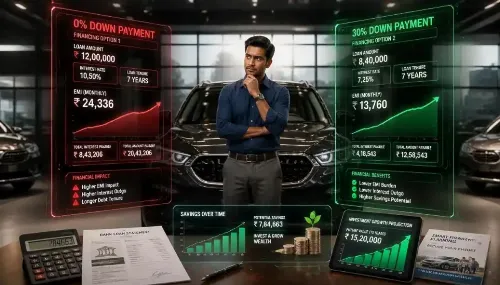
Learn the ideal car loan down payment in India. Compare EMI, interest costs, loan approval chances, and total ownership costs with real examples.
Most car buyers ask one question at the showroom: what is the EMI? The right question is: how much should I put down? The two are connected, but the down payment decision affects your total loan cost, your interest rate, your loan approval odds, and whether you are financially trapped the moment you drive out.
This article runs the actual numbers across five down payment scenarios on the same car, so you can see exactly what each choice costs you over the full loan period.
Why Down Payment Matters More Than the EMI
The EMI is what you pay every month. The down payment determines everything else: the size of your loan, the interest rate the bank offers, the total interest you pay over the tenure, and how quickly your loan balance falls below the car's resale value.
Dealers and lenders naturally focus your attention on the EMI because a smaller monthly number feels manageable. The down payment feels like a one-time sacrifice. In reality, a larger down payment saves you far more money over the full loan period than any EMI negotiation ever will.
The 20-4-10 rule sets 20% as the minimum down payment threshold. For the full framework behind that figure, see our 20-4-10 rule guide. This article focuses specifically on what happens mathematically when you go above or below that threshold.
The Zero-Down Trap: Negative Equity from Day One
A zero-down-payment loan means you borrow the full on-road price. The problem is not just the larger EMI. It is that your loan balance and your car's resale value move in opposite directions from the moment you drive out.
A new car loses approximately 20% of its value in the first year and a further 15% in year two. Here is what that looks like against the outstanding loan balance on a ₹6,00,000 on-road car with zero down payment at 9.5% over 48 months:
| Time Point | Car Resale Value | Loan Balance Remaining | Your Equity |
|---|---|---|---|
| Day 1 (purchase) | ₹6,00,000 | ₹6,00,000 | ₹0 |
| End of Year 1 | ₹4,80,000 | ₹4,70,574 | ₹9,426 |
| End of Year 2 | ₹4,08,000 | ₹3,28,303 | ₹79,697 |
On a zero-down loan at 9.5% over 48 months, you technically stay above zero equity due to the loan amortisation pace at this rate. However, the margin at end of Year 1 is just ₹9,426 on a ₹6 lakh asset. Any increase in loan rate, an extended tenure beyond 48 months, or a car with faster depreciation (diesel variants, luxury segment, or high-mileage use) will push that margin into negative territory.
Down Payment Comparison: 0% to 40% on a ₹6 Lakh Car
Same car (₹6,00,000 on-road), same 48-month tenure. The interest rate changes with the down payment because a lower loan-to-value ratio reduces the bank's risk. This is the table the showroom finance manager will not show you:
| Down Payment | Amount Paid Upfront | Loan Amount | Interest Rate (LTV-based) | Monthly EMI | Total Interest Paid | Total Outflow |
|---|---|---|---|---|---|---|
| 0% (zero down) | ₹0 | ₹6,00,000 | 10.5% | ₹15,362 | ₹1,37,377 | ₹7,37,377 |
| 10% | ₹60,000 | ₹5,40,000 | 10.0% | ₹13,696 | ₹1,17,398 | ₹7,17,398 |
| 20% | ₹1,20,000 | ₹4,80,000 | 9.5% | ₹12,059 | ₹98,837 | ₹6,98,837 |
| 30% | ₹1,80,000 | ₹4,20,000 | 9.0% | ₹10,452 | ₹81,682 | ₹6,81,682 |
| 40% | ₹2,40,000 | ₹3,60,000 | 8.5% | ₹8,873 | ₹65,923 | ₹6,65,923 |
Every 10% increase in down payment saves approximately ₹15,000 to ₹20,000 in total interest and reduces your EMI by roughly ₹1,200 to ₹1,500 per month. The total outflow difference between zero down and 40% down on the same car is ₹71,454 — on interest alone, before factoring in the rate benefit of a lower LTV.
How Down Payment Percentage Affects Loan Approval and Interest Rate
Banks calculate your loan-to-value (LTV) ratio when processing a car loan application. LTV is simply the loan amount divided by the car's on-road price. A lower LTV means lower risk for the bank, which typically translates into a faster approval and a better interest rate offer.
Most Indian banks cap car loans at 85 to 90% LTV for new cars, meaning they require a minimum 10 to 15% down payment as a condition of approval. A 20% or higher down payment does two things beyond hitting the minimum: it demonstrates financial discipline to the lender, and it qualifies you for the lower LTV rate band.
The comparison table above shows this directly: moving from 0% to 20% down reduces your interest rate from 10.5% to 9.5%. On a ₹4,80,000 loan over 48 months, that 1% rate difference saves ₹11,065 in interest, purely from having a larger down payment, before any EMI negotiation.
The Emergency Fund Rule: What Not to Touch for Down Payment
Saving aggressively for a down payment is the right instinct. Wiping out your entire liquid savings to hit 20% is not. Before you calculate how much to put down, you need to ring-fence one amount that is off-limits: your emergency fund.
A car purchase that empties your savings account leaves you with a large monthly EMI and zero buffer. The first unexpected expense, whether it is a medical bill, a job disruption, or a home repair, becomes a missed EMI. A missed EMI damages your CIBIL score, and a damaged CIBIL score raises your interest rate on any future borrowing.
The rule is straightforward: your emergency fund (3 months of essential expenses, kept liquid) must remain untouched after the down payment is made. If you cannot make the 20% down payment and keep 3 months of expenses in reserve, you are not ready to buy yet.
Saving Strategies to Build a 20 to 30% Down Payment
Knowing the right down payment percentage is one thing. Building the corpus before you walk into a showroom is the actual work. Here is how to approach it systematically on a ₹30,000 to ₹50,000 salary.
Step 1: Set a Fixed Target Before You Start
Decide the on-road price of the car you are targeting and calculate 20% of that number. For a ₹6L car, that is ₹1,20,000. For a ₹8L car, that is ₹1,60,000. Write this number down. Vague saving ("I will put aside whatever is left") produces vague results.
Step 2: Open a Separate Savings Account for This Goal
Keep the down payment fund in a separate account from your salary account and emergency fund. Visibility and separation prevent casual withdrawals. A recurring deposit or a liquid mutual fund SIP works well for this: the money grows slightly, it is accessible when needed, and the automatic deduction removes the temptation to skip a month.
Step 3: Calculate Your Timeline Honestly
| Salary | Monthly Saving | Time to ₹1.2L (20% of ₹6L) | Time to ₹1.8L (30% of ₹6L) |
|---|---|---|---|
| ₹30,000 | ₹4,500 (15%) | 27 months | 40 months |
| ₹30,000 | ₹6,000 (20%) | 20 months | 30 months |
| ₹40,000 | ₹6,000 (15%) | 20 months | 30 months |
| ₹40,000 | ₹8,000 (20%) | 15 months | 23 months |
| ₹50,000 | ₹7,500 (15%) | 16 months | 24 months |
| ₹50,000 | ₹10,000 (20%) | 12 months | 18 months |
These timelines assume a dedicated saving rate with no withdrawals. Any salary increment during the saving period shortens the timeline. Factor in festive season bonuses or annual increments, and the 20% target is reachable in 12 to 18 months for most ₹40,000 to ₹50,000 salary earners.
When Paying Full Cash Is the Right Decision
If you have the liquid savings to buy the car outright, the instinct to "invest the money instead" needs to pass one test: is your guaranteed post-tax return on that investment higher than the 9 to 10.5% interest rate on a car loan?
A fixed deposit returns 6.5 to 7.5% pre-tax. After tax, the real return for someone in the 20% or 30% tax bracket drops to 5.2 to 6%. A car loan at 9.5% is a guaranteed 9.5% cost. The math consistently favours paying cash over keeping money in conservative instruments and taking a loan.
The exception is if paying full cash wipes out your emergency fund or liquidates a long-running equity investment (where expected returns over 5 years may reasonably exceed 10%). In that case, make the largest down payment that leaves your emergency fund intact and your SIPs running, then take a loan for the balance.
Frequently Asked Questions
What is the ideal down payment percentage for a car loan in India?
20% is the minimum threshold to get a competitive interest rate and avoid a near-zero equity position in year one. 30% is better if your salary allows it, the interest savings are meaningful and the EMI drops to a safer level. Below 20%, both your rate and your total cost increase noticeably.
Is a zero down payment car loan ever a good idea?
Rarely. Zero down means maximum loan, maximum interest rate, and minimum equity. The total outflow on a zero-down 7-year loan versus a 20% down 4-year loan on the same ₹6L car differs by over ₹1.24 lakh. The lower EMI of zero down is not a saving, it is a longer and more expensive obligation.
Should I break my fixed deposit to make a bigger car down payment?
If the FD is earning 6.5 to 7.5% pre-tax and the car loan costs 9.5 to 10.5%, breaking the FD to reduce the loan saves you money. Do not break your emergency fund. Do not break an equity SIP that has been running for over 3 years. Everything else is worth evaluating against the loan interest rate.
What happens if I cannot afford a 20% down payment right now?
Wait and save. Use the saving timeline table in this article to set a realistic target month. A 15% saving rate on ₹40,000 salary gets you to ₹1.2L in 20 months. The car will still be available. Your interest cost and monthly EMI will both be lower for the wait. Rushing in with 10% or less costs you significantly more over 4 years.
Conclusion
The down payment is not a deposit. It is the single variable with the most leverage over your total car ownership cost. Every additional percentage point you put down reduces your loan amount, lowers your interest rate, shrinks your EMI, and improves your financial position from day one.
Run your specific numbers before committing to anything. The Car Affordability Calculator lets you compare down payment scenarios instantly, in your browser, with no login required. Put in 10%, then 20%, then 30% on the same car price and watch what happens to the total interest line. That number is what the decision is actually about.
Save the down payment first. Buy the car second. In that order, every time.