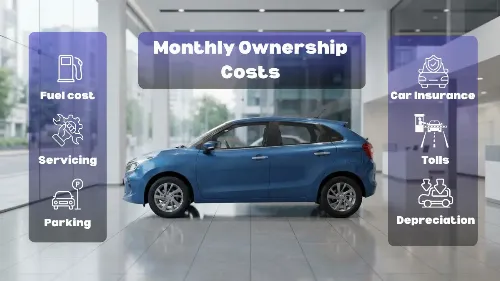
Most car buyers budget only for the EMI. Discover the hidden monthly costs of owning a car in India, including fuel, insurance, servicing, parking, tolls, and depreciation that can add over ₹8 lakh in 4 years.
The EMI cleared on the first of the month. The car is parked downstairs. Everything feels manageable. Then the second month arrives, and petrol needs filling. Then the FASTag balance runs out. Then the society sends a parking bill. Then in month thirteen, a ₹18,000 insurance renewal notice lands in your inbox and nothing in your budget is set aside for it.
This is the moment most Indian car owners realise that the EMI was only one part of what they signed up for. This article shows you every cost that appears after the purchase, what each one actually amounts to per month, and what the full picture looks like across 4 years of ownership.
The Complete Monthly Cost Breakdown
The numbers below are based on a ₹5.5 lakh on-road entry hatchback, petrol variant, used for approximately 1,200 km per month in a Tier-1 or Tier-2 Indian city. These are real recurring costs, not estimates pulled from a brochure.
| Cost Category | Year 1 Monthly | Year 2 Monthly | Year 3 Monthly | Year 4 Monthly |
|---|---|---|---|---|
| Fuel (1,200 km at 18 kmpl, ₹105/L) | ₹7,000 | ₹7,000 | ₹7,000 | ₹7,000 |
| Insurance (bundled in Year 1 on-road price) | ₹0 | ₹1,500 | ₹1,000 | ₹875 |
| Scheduled servicing | ₹292 | ₹500 | ₹625 | ₹1,000 |
| Tyre replacement reserve | ₹0 | ₹400 | ₹400 | ₹400 |
| Battery replacement reserve | ₹0 | ₹131 | ₹131 | ₹131 |
| Parking charges | ₹1,500 | ₹1,500 | ₹1,500 | ₹1,500 |
| Tolls and FASTag recharges | ₹1,000 | ₹1,000 | ₹1,000 | ₹1,000 |
| Total monthly running cost | ₹9,792 | ₹11,531 | ₹11,656 | ₹11,906 |
Year 1 looks the most affordable because insurance is already paid as part of the on-road price. From Year 2 onward, the real monthly cost settles at approximately ₹11,500 to ₹12,000 per month, before the EMI. Most buyers budgeted for only the EMI.
The Insurance Renewal Shock
First year insurance is quietly bundled into the on-road price at the time of purchase. You pay it once as part of the total bill, and then you drive away. It does not feel like a separate cost because it is not presented as one.
Month 13 changes that completely. The renewal notice arrives for the full annual premium in one shot. For a ₹5.5 lakh entry hatchback, a comprehensive Year 2 policy without any add-ons costs approximately ₹14,000. Add a zero-depreciation cover, which most lenders require during the loan period, and it goes to ₹18,000.
That is ₹18,000 due in a single month, on top of your regular EMI and running costs. Very few first-time buyers have this amount sitting in a separate account ready to go. The ones who do not either let the comprehensive cover lapse and keep only third-party insurance, or they put the renewal on a credit card and pay 36 to 42% annual interest on it for the next few months.
How to Handle It Without a Budget Shock
Divide your expected Year 2 renewal amount by 12 and set that aside every month from the day you buy the car. On a ₹18,000 renewal, that is ₹1,500 per month going into a separate savings account. When the renewal arrives in month 13, the money is already there.
Year by Year: How Costs Change Over 4 Years
Most car buyers think running costs are fixed after purchase. They are not. The cost profile shifts meaningfully between Year 1 and Year 4 as warranty coverage ends and components approach replacement age.
| Year | Total Running Cost | Key Cost Driver That Year |
|---|---|---|
| Year 1 | ₹1,17,504 (₹9,792/mo) | Fuel and parking only. Insurance in on-road price. First service mostly free or low cost. |
| Year 2 | ₹1,38,372 (₹11,531/mo) | Insurance renewal hits. Tyre and battery reserves begin. 20k and 30k services due. |
| Year 3 | ₹1,39,872 (₹11,656/mo) | Insurance slightly lower. 40k service is typically the most expensive in-warranty service. |
| Year 4 | ₹1,42,872 (₹11,906/mo) | Warranty expires. Servicing moves post-warranty. Costs begin climbing. |
| 4-Year Total | ₹5,38,620 | Running costs alone equal nearly the original on-road price over 4 years. |
The 4-year running cost of ₹5.38 lakh is before depreciation and before EMI interest. Add those in and the true cost of owning a ₹5.5 lakh car for 4 years is significantly higher than most buyers expect on purchase day.
The Post-Warranty Servicing Cost Jump
Most entry hatchbacks come with a 3-year or 1,00,000 km warranty, whichever comes first. While the car is under warranty, you service it at the authorised dealer. The rates are fixed, transparent, and include labour. The downside is that authorised dealer service rates are meaningfully higher than independent garages.
Once the warranty expires, two things happen. First, you are free to service the car at any trusted independent garage, where labour rates are typically 30 to 40% lower. Second, the car starts showing wear on components that were previously covered: brake pads, suspension bushings, clutch cable, cooling system parts.
A realistic Year 4 servicing budget for a small hatchback at an independent garage, including one or two small repairs, runs ₹10,000 to ₹14,000 per year. That is ₹833 to ₹1,167 per month set aside just for maintenance. The pattern generally worsens from Year 5 onward as the car ages further.
Depreciation: The Cost Nobody Puts in Their Monthly Budget
Depreciation is real money leaving your hands. It simply leaves slowly and silently rather than on the first of each month. When you eventually sell or trade in the car, the difference between what you paid and what you receive is a cost you have been absorbing throughout the ownership period.
For a ₹5.5 lakh on-road entry hatchback, the depreciation curve looks like this:
| Year | Approximate Resale Value | Value Lost That Year | Monthly Equivalent |
|---|---|---|---|
| Purchase day | ₹5,50,000 | ₹0 | ₹0 |
| End of Year 1 | ₹4,40,000 | ₹1,10,000 | ₹9,167 |
| End of Year 2 | ₹3,74,000 | ₹66,000 | ₹5,500 |
| End of Year 3 | ₹3,17,900 | ₹56,100 | ₹4,675 |
| End of Year 4 | ₹2,70,215 | ₹47,685 | ₹3,974 |
| 4-Year Total Loss | ₹2,70,215 resale | ₹2,79,785 | ₹5,829/month average |
Year 1 is by far the most expensive depreciation year. The car loses ₹1,10,000 in value in 12 months, which works out to ₹9,167 per month. This is money you will never recover regardless of how well you maintain the car. If you factor depreciation into your true monthly cost of ownership, the number in Year 1 is considerably higher than most buyers realise.
If you are wondering why your EMI feels so heavy even when you budgeted for it, this is a large part of the answer. Our article on why car EMI feels expensive covers the psychology behind this in detail.
Own Car vs Cab vs Metro: The Honest Monthly Comparison
For a 25 km one-way daily commute across 22 working days per month (1,100 km per month of commuting), here is what each option actually costs:
| Transport Option | Monthly Cost | What It Includes |
|---|---|---|
| Own car (fuel only) | ₹6,417 | Petrol for commute distance only |
| Own car (full cost) | ₹9,694 | Fuel, pro-rated insurance, servicing, parking, tolls |
| Uber or Ola | ₹15,400 | ₹14/km average, door to door |
| Auto rickshaw | ₹13,200 | ₹12/km average |
| Metro | ₹1,800 | Monthly pass equivalent, Tier-1 city |
For pure commuting, a car beats Uber and auto on running cost but loses badly to metro. The car starts making financial sense only when you factor in trips that metro or auto cannot cover: weekend travel, family outings, late night returns, areas with no public transport coverage.
If your primary use case is a metro-serviced commute route, the numbers above suggest that owning a car for commuting alone is not the most cost-efficient choice. The car earns its keep on the utility it provides beyond the daily commute, and that utility varies significantly by city and lifestyle.
Frequently Asked Questions
What is the total monthly cost of owning a car in India beyond the EMI?
For an entry hatchback in a Tier-1 or Tier-2 city, expect ₹9,500 to ₹12,000 per month in running costs on top of your EMI from Year 2 onward. This includes fuel, insurance, servicing, tyres, battery reserve, parking, and tolls. Year 1 is lower because insurance is bundled into the on-road price.
Why does car insurance cost more in Year 2 than Year 1?
Year 1 insurance is paid upfront as part of the on-road price at purchase, so it does not feel like a separate monthly expense. From Year 2, you pay the full annual renewal as a single payment, typically ₹12,000 to ₹18,000 depending on the car and add-ons. Budget ₹1,000 to ₹1,500 per month starting from purchase day to avoid the shock.
How much does servicing cost after warranty expires?
Post-warranty servicing at an independent garage for a small hatchback typically runs ₹10,000 to ₹14,000 per year, compared to ₹6,000 to ₹8,000 per year during the warranty period at an authorised dealer. The cost increases further from Year 5 as wear items like brake pads, suspension parts, and belts need more frequent attention.
Is owning a car cheaper than using Uber or Ola daily?
For a 25 km daily commute, owning a car costs approximately ₹9,700 per month in running costs versus ₹15,400 per month on Uber. The car is cheaper for regular commuting but only after factoring in the full EMI, depreciation, and down payment capital locked in. Metro remains the cheapest option where available.
Conclusion
The showroom presents one number: the EMI. The actual cost of car ownership is that EMI plus ₹9,500 to ₹12,000 per month in running costs, plus ₹5,829 per month in depreciation that silently erodes your asset. Over 4 years on a ₹5.5 lakh car, the non-EMI costs alone add up to over ₹8 lakh.
None of this means a car is the wrong choice. It means the decision needs to be made with the full number, not just the EMI.
Know the full cost. Then decide.Use our Car Ownership Cost Calculator to build your own month-by-month cost model before you sign anything.