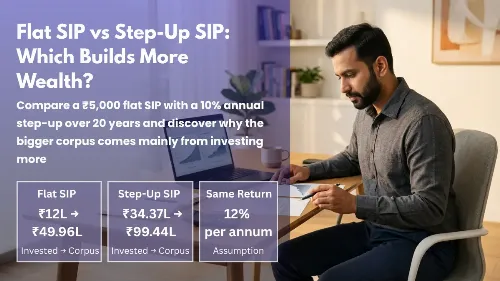
Compare a flat SIP and a 10% Step-Up SIP over 20 years. See total investment, year-by-year growth, and whether increasing your SIP really pays off.
A step-up SIP that starts at ₹5,000 and goes up 10% every year builds a much bigger amount than a flat ₹5,000 SIP over 20 years, roughly ₹99.4 lakh against ₹49.9 lakh, at the same 12% yearly return for both. But this big gap is not mainly because of compounding working harder. It happens because with the step up SIP, you end up putting in nearly three times more money in total, ₹34.4 lakh instead of ₹12 lakh. And looking at how much each rupee grows, the flat SIP does a better job.
This article shows the full year-by-year numbers for both, explains why the step-up advantage is mostly about putting in more money rather than better growth, and helps you pick a step-up percentage your income can handle.
What a Step-Up SIP Means
A step-up SIP means increasing your monthly investment by a fixed percentage every year, instead of investing the same amount for the whole period. Start at ₹5,000, add 10% at the end of year one, and you are now paying ₹5,500 a month in year two, then ₹6,050 in year three, and so on, every year a little more.
The thinking behind this is simple. Most people's salaries grow over time, so the SIP amount should grow with it too, instead of staying stuck at the number that felt comfortable when you first started. If you have not seen how a plain flat SIP grows over time, our article on what a ₹5,000 SIP for 20 years becomes covers that first.
Fixed SIP vs. Step-Up SIP: 20 Years, Side by Side
Both SIPs here start at ₹5,000 a month and assume the same 12% yearly return used throughout this series. That 12% is a long-term historical average for Indian equity funds. It is not a promise or a guarantee, and this comparison is meant to show you the shape of the difference, not tell you what will happen to your money.
| Year | Fixed SIP Invested | Fixed SIP Value | Step Up SIP Invested | Step Up SIP Value |
|---|---|---|---|---|
| Year 5 | ₹3,00,000 | ₹4,12,432 | ₹3,66,306 | ₹4,92,285 |
| Year 10 | ₹6,00,000 | ₹11,61,695 | ₹9,56,245 | ₹16,87,163 |
| Year 15 | ₹9,00,000 | ₹25,22,880 | ₹19,06,349 | ₹43,41,925 |
| Year 20 | ₹12,00,000 | ₹49,95,740 | ₹34,36,500 | ₹99,44,358 |
By year 20, the gap between the two final amounts comes to close to ₹49.5 lakh. That number sounds huge, and it is real, but it did not appear out of nowhere. Both figures are also nominal, meaning neither one adjusts for what inflation does to that money's value by the time year 20 arrives, a question we cover fully in our article on SIP returns versus inflation and real returns.
Why This Gap Happens, and Why It Is Not Quite What It Looks Like
Look at the invested column, not just the final value column. Over 20 years, the step-up SIP put in ₹34.37 lakh of your own money, compared to just ₹12 lakh for the flat SIP. That is nearly ₹22.4 lakh more of your own money going in, not money the market handed you.
Now set that aside and look only at how much each path grew on the money that went in. The flat SIP turned ₹12 lakh into a gain of about ₹37.96 lakh, close to 3.2 times what was invested. The step-up SIP turned ₹34.37 lakh into a gain of about ₹65.08 lakh, only around 1.9 times what was invested.
So per rupee, the flat SIP grew better. That sounds odd until you notice when the extra money in a step up SIP goes in. Your monthly amount is smallest in year one and biggest in year twenty, so the largest installments land right near the end, with the least number of years left to grow.
None of this means the step-up SIP is a poor choice. Its final amount is much bigger, and for many people, putting in more money as their salary grows is exactly the point. But most of that bigger number comes from the bigger commitment, not from some hidden compounding trick the flat SIP was missing out on.
The Real Catch: Your Income Has to Rise
A step-up SIP only makes sense if your salary grows enough to support it without putting a strain on your monthly budget. In this example, by year 20 the monthly payment has grown from ₹5,000 to over ₹30,000, more than six times higher over two decades.
If your salary keeps pace with that kind of growth, raising your SIP alongside it barely changes how your month feels, since the extra amount reflects money you would not have had access to in year one anyway. But if your income grows slower than that, or stays flat for a stretch, a fixed step-up percentage can quietly become a real burden that a plain flat SIP never creates.
This is exactly the part a calculator cannot decide for you. The maths for a step-up SIP looks clean and easy on paper. Whether it actually fits your month-to-month budget is a separate question and one worth checking properly rather than guessing, using our free Income Expense Planner, before you commit to a rising SIP amount for the next 20 years.
How to Choose a Step-Up Percentage That Fits You
Rather than picking a round number like 10% because it is the most commonly used figure, a more honest way to decide is to look at your own average salary growth over a few years, not just your one best year.
If your take-home pay has grown by roughly 6 to 8% a year on average, a step-up SIP in that same range keeps your investment growing at a pace you can afford, without cutting into money you need for rent, daily expenses, or other goals. If your salary growth has been closer to 12 to 15%, a bigger step up becomes reasonable without adding real pressure.
The goal is not to match the biggest number you have seen in some article. It is to pick a percentage that survives a slow year without forcing you to stop the SIP altogether, since a step-up SIP that gets abandoned halfway saves you far less than a smaller one that keeps running the whole way through.
Frequently Asked Questions
Is a 10% yearly step up right for everyone?
No. Ten percent is just a commonly used example figure, not a recommendation. The right step-up percentage depends on your own salary growth, and a smaller percentage you can keep up every year beats a bigger one you eventually have to stop.
Does a step-up SIP always beat a flat SIP?
In terms of the final amount, yes, since you end up investing more money overall. But it only works if your income can support the rising monthly payment without straining your budget in a slower year.
Why does the step-up SIP look so much bigger if the return rate is the same?
Mostly because you invest a lot more money over 20 years, not because step-up payments grow faster. The bigger, later payments have less time left to grow compared to the smaller, earlier payments in a flat SIP.
Should I start with a step-up SIP or a flat SIP?
Either can work well. A flat SIP is simpler and more predictable if your income is uncertain. A step-up SIP suits someone with a genuinely rising salary, since it keeps your investment growing alongside money you already expect to earn.
See What Your Own Step-Up Numbers Look Like
The gap between a flat SIP and a step up SIP was never really about which one grows better on its own. It comes down to how much money you put in over 20 years and whether that pace matches what your income can support.
Use our free Step-up SIP Calculator to try different step-up percentages against your own numbers and see what a realistic increase, not just a round one, would actually build for you.