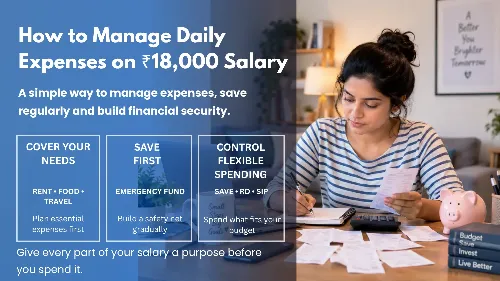
Earning ₹18,000 a month? Learn how to manage rent, food and daily expenses, save regularly, build an emergency fund and make your salary last.
Rent comes first. Then groceries, phone recharge, travel and other monthly expenses. By the middle of the month, a ₹18,000 salary can feel like there is hardly anything left.
Managing daily expenses on ₹18,000 is possible, but you need a simple plan. The first step is to understand where your salary goes. Then you can decide how much to spend, how much to save and where you can cut unnecessary costs.
You do not have to stop spending on everything you enjoy. The goal is to cover your important expenses first, keep some money aside and make your monthly budget easy enough to follow.
Check Your Own Numbers: Use our free Expense Planner to see a budget based on your income and housing situation. You can also use the Contingency Fund Tracker to set and track your emergency fund.
What Does an ₹18,000 Salary Budget Look Like?
The popular 50-30-20 rule does not always work well when you earn ₹18,000 a month. Your rent, food and travel costs can already take a large part of your salary.
FinTool Baba's Expense Planner uses a 65% needs, 20% wants and 15% savings split for the ₹15,000 to ₹25,000 income range. For an ₹18,000 salary, that gives this starting point:
| Category | Share of Income | Amount |
|---|---|---|
| Needs (rent, groceries, transport, utilities) | 65% | ₹11,700 |
| Wants (dining, entertainment, small purchases) | 20% | ₹3,600 |
| Savings (emergency fund, SIP, RD) | 15% | ₹2,700 |
This is a starting point, not a rule that everyone has to follow. Your rent may be higher, your travel costs may be different and you may also have family responsibilities.
If your basic expenses are higher than ₹11,700, do not assume that you have failed at budgeting. Look at your flexible spending first and see where you can make some room for savings.
How to Control Daily Expenses on ₹18,000
Small daily expenses can add up quickly. Food delivery, extra cab rides, online shopping and other unplanned purchases can slowly reduce the money you have left for savings.
Start by checking your spending for one month. Look at where your money actually goes instead of trying to guess it.
For example, you may notice that you are spending more on food outside than you expected. You may also find that frequent cab rides, shopping or small online purchases are taking more money than planned.
You do not have to remove every one of these expenses. The idea is to find the spending that can be reduced without making your daily life difficult.
Know Which Expenses You Can Change
Some expenses are difficult to change every month. Rent is a good example. If your rent is fixed, you cannot simply reduce it whenever your budget is short.
Other expenses are more flexible. Eating out, entertainment, extra travel and shopping can usually be adjusted when you need to save more.
Example: If your rent stays the same but you reduce a few unnecessary food orders or cab rides during the month, the money saved can go toward your emergency fund.
This does not mean you have to avoid every small enjoyment. A budget works better when it leaves some room for normal life.
Build an Emergency Fund Slowly
An emergency fund gives you money to use when something unexpected happens. It can help with an urgent medical expense, a sudden repair or a period when your income is not available.
A useful target is around 3 to 6 months of essential expenses. The target should be based on your basic monthly expenses rather than simply using your full salary.
Example: If your essential expenses are around ₹11,700 a month, a 3-month emergency fund would be ₹35,100. A 6-month emergency fund would be ₹70,200.
These figures are only an example. Your own emergency-fund target can be different depending on your actual essential expenses and responsibilities.
With an ₹18,000 salary, building the full amount can take time. That is normal. You do not need to reach the target in one or two months. Start with an amount you can manage and keep adding to it regularly.
Use the Contingency Fund Tracker to set your own target and keep track of how much you have already saved.
Where Can Small Monthly Savings Go?
Once your emergency fund has started building, you can think about longer-term savings. You do not need a large amount to begin.
Example: If your budget allows you to save a small amount every month after covering your essential expenses, start with an amount that you can continue without putting pressure on your monthly budget.
An SIP is linked to market performance, while an RD is a fixed-return savings option. Your choice can depend on your goal, time period and comfort with risk.
If you want to compare these two options, our RD vs SIP comparison looks at a ₹5,000 monthly contribution over five years. You can also read our guide to how RD interest is actually calculated to understand how an RD grows.
Your monthly amount does not have to be ₹5,000. Enter your own amount into the SIP Calculator or RD Calculator to check the numbers that fit your budget.
For very small monthly savings, India Post's Recurring Deposit scheme accepts deposits starting from ₹100 a month. You can check the National Savings Institute's official page for the current interest rate and applicable scheme details before opening an RD.
Checking the current rate is useful because small-savings rates can change over time. The official government page is the better place to confirm the applicable rate when you are ready to invest.
Starting small is fine. At this stage, the main aim is to build a saving habit that you can continue and increase when your income improves.
Can You Start Retirement Planning on ₹18,000?
Retirement may not feel like an urgent priority when most of your salary goes toward everyday expenses. Still, starting with a small amount can help you begin planning for the future.
The Atal Pension Yojana (APY) is a government-backed pension scheme run by the Pension Fund Regulatory and Development Authority. The contribution depends on your age when you join and the pension amount you choose.
Example: For someone joining at age 25, the contribution chart shows the following monthly contributions:
| Guaranteed Monthly Pension from Age 60 | Monthly Contribution at Age 25 |
|---|---|
| ₹1,000 | ₹76 |
| ₹2,000 | ₹151 |
| ₹3,000 | ₹226 |
| ₹5,000 (maximum) | ₹376 |
The figures above are an example based on joining at age 25 and the pension choices shown in the contribution chart. Your contribution can be different depending on your age and selected pension.
Before joining, check the current APY rules, eligibility conditions and contribution details on the official PFRDA APY page.
APY should not replace your emergency savings or money needed for your regular expenses. It is simply one option to understand if you are eligible and want to start thinking about retirement.
Common Money Mistakes on an ₹18,000 Salary
One of the biggest mistakes is waiting until the end of the month to save. When your salary is limited, daily expenses can use up most of your money before you get to the last few days.
A better approach is to decide how much you want to save when your salary arrives and keep that amount aside first.
Another mistake is copying someone else's budget. For example, if another person pays ₹6,000 in rent and you pay ₹9,000, your monthly budget cannot be exactly the same even though both of you earn ₹18,000.
It is also easy to treat every expense as a need. Some expenses are necessary, while others can be reduced, delayed or removed when money is tight.
At the same time, avoid making a budget that is too strict. If your plan leaves no money for anything you enjoy, it may become difficult to follow for a long time.
A Simple Monthly Plan for ₹18,000
You do not need a complicated system to manage your salary. Give your money a clear order when you receive it.
First: Keep money aside for rent, groceries, transport, utilities and other essential expenses.
Second: Put your planned savings aside soon after receiving your salary.
Third: Keep a separate amount for flexible spending such as eating out, entertainment and personal purchases.
Fourth: Check your spending at the end of the month and see where you can improve next month.
If your salary increases later, consider increasing your savings before increasing every part of your spending. Even a small increase in monthly savings can help you build your financial cushion faster.
Frequently Asked Questions
How much should I save from an ₹18,000 salary?
FinTool Baba's budgeting framework uses a 15% savings allocation for the ₹15,000 to ₹25,000 income bracket. On an ₹18,000 salary, this gives a starting point of ₹2,700 a month. Your actual saving amount can be different depending on your expenses.
Can I start investing with an ₹18,000 salary?
Yes. Start with an amount that fits comfortably after your essential expenses. It is also useful to build an emergency fund so that an unexpected expense does not force you to stop your regular savings.
How much emergency fund do I need on an ₹18,000 salary?
Base the target on your essential monthly expenses. For example, if your essential expenses are ₹11,700, a 3-month fund would be ₹35,100 and a 6-month fund would be ₹70,200.
Can I start an RD with a small amount?
Yes. India Post's Recurring Deposit accepts deposits starting from ₹100 a month. Before opening an RD, check the current interest rate and scheme rules on the official National Savings Institute page. You can also use the RD Calculator to check your own monthly amount.
Can I plan for retirement on an ₹18,000 salary?
Yes, you can start small. The Atal Pension Yojana is one government-backed option with contributions based on age and the pension amount selected. Check the current scheme rules and your eligibility before joining.
Put Your Own Numbers In
The 65%, 20% and 15% split is a starting point. Your actual budget depends on your rent, travel costs, family responsibilities and other monthly expenses.
Enter your actual income and housing details into the Expense Planner to get a budget that is closer to your situation. Then use the Contingency Fund Tracker to set an emergency-fund target.
Once you have started building your emergency savings, you can use the SIP Calculator or RD Calculator to check what your own monthly saving amount could become over time.
You do not need a perfect budget from the first month. Start by understanding your expenses, control the spending you can control, save a small amount regularly and increase your savings as your income improves.