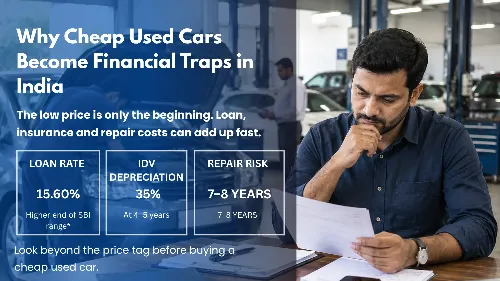
Think a cheap used car saves money? Discover the hidden repair costs, depreciation, and ownership expenses that can make older used cars the more expensive choice.
An 8-year-old hatchback for ₹1.6 lakh looks like an easy win next to a 4-year-old version of the same car at ₹3.5 lakh. The sticker price says you saved almost ₹2 lakh. But the sticker price is only the first number in the equation, not the last one.
Once you add in the loan rate an older car actually qualifies for, how fast its insurance value falls, and how often it needs to visit a garage, that "saving" can shrink fast, and sometimes disappear completely within a couple of years. This is what turns a cheap used car into a financial trap: not the price you paid, but the costs that show up after.
The Price Tag Is Not the Cost
When two used cars are compared, most buyers compare only the asking price. But an old car and a newer used car are not the same product wearing different price tags. They come with different loan rates, different insurance behaviour, and a different chance of needing repairs soon after you buy them.
Each of these three factors moves in the same direction as the car's age: older usually means a higher loan rate, a faster-falling insurance value, and a higher chance of repair spending. A cheap old car can still be the right choice, but only if you have actually added these up, not assumed the lower price automatically means the lower total cost.
An Older Car Usually Gets a Higher Loan Rate
Lenders price a used-car loan around the car's age, not just the buyer's credit profile. An older vehicle depreciates faster and is harder to resell if the loan defaults, so banks build that risk into the interest rate.
| Loan Scheme | Published Interest Rate |
|---|---|
| SBI Certified Pre-Owned Car Loan Scheme | 10.45% – 15.60% p.a. (credit-score based) |
SBI's official auto loan interest rate page currently lists this range for its Certified Pre-Owned Car Loan Scheme, last updated on 18 August 2026. You can check the current figures on the official SBI Auto Loans interest-rate page.
What the Rate Difference Actually Costs
Here is an illustrative scenario to show why the rate matters, not just the loan amount.
Car A (older, cheaper): An 8-year-old hatchback bought for ₹1.8 lakh. The buyer takes a loan of ₹1.2 lakh at 15.60% for 4 years, the higher end of SBI's published range, reflecting the greater risk lenders attach to an older car.
Car B (newer, pricier): A 4-year-old version of the same hatchback bought for ₹3.6 lakh. The buyer takes a loan of ₹2.4 lakh at 10.45% for 4 years, the lower end of the same published range.
| Detail | Car A (Older, Cheaper) | Car B (Newer, Pricier) |
|---|---|---|
| Loan amount | ₹1,20,000 | ₹2,40,000 |
| Interest rate | 15.60% p.a. | 10.45% p.a. |
| Tenure | 4 years | 4 years |
| Approx. monthly EMI | ₹3,376 | ₹6,142 |
| Approx. total interest paid | ₹42,048 | ₹54,816 |
This is a hypothetical example for calculation purposes only, based on the published SBI rate band. Car B still costs more in total interest here because the loan amount is double. But notice how much of Car A's "cheap car" advantage the higher rate alone eats into on a much smaller loan. On a bigger old-car loan, or with an NBFC charging a further premium for an older vehicle, that gap narrows a lot faster than the price tag suggests.
Whether you are comparing a ₹1 lakh loan or a ₹4 lakh loan, the same principle applies: check the rate you actually qualify for on that specific car's age, not the lowest rate advertised for a new car.
Insurance Value Falls Faster Than People Expect
Every motor insurance policy in India is built around a figure called the Insured Declared Value, or IDV. This is roughly what the insurer will pay you if the car is stolen or damaged beyond repair. The IDV is not a flat number; it is reduced every year using a standard age-based depreciation schedule set by the Insurance Regulatory and Development Authority of India (IRDAI).
| Age of Vehicle | Depreciation Applied to IDV |
|---|---|
| 6 months – 1 year | 5% |
| 1 – 2 years | 10% |
| 2 – 3 years | 15% |
| 3 – 4 years | 25% |
| 4 – 5 years | 35% |
This schedule, based on the IRDAI's standard depreciation slabs, is summarised on Bajaj Finserv's IDV calculator page. For cars older than 5 years, the IDV is generally settled between the insurer and the owner rather than through a fixed slab, which usually works out lower still.
What this means in practice: on an old, cheap used car, you are paying a premium every year while the amount you would actually get back in a total-loss claim keeps shrinking. A newer used car holds a meaningfully higher IDV for longer, which matters if the car is ever stolen or written off. This is a real, ongoing cost of an old car that rarely shows up when you are only comparing purchase prices.
Repairs Rise Faster on Older Cars
The third piece is maintenance. As a car crosses roughly seven to eight years of age, the pace at which components wear out tends to increase noticeably compared to a car that is five or six years old. Suspension parts, the clutch, batteries, and rubber and plastic components common in older vehicles typically need replacing more often once a car crosses this age band.
We have covered this in detail, with year-by-year expected spending, in our used car maintenance cost guide. If you are looking at a car older than 7-8 years specifically because the price looks attractive, it is worth reading that guide before you finalise anything, since repair spending is usually the single biggest hidden cost on an old car.
Put the Three Costs Together
None of these three costs, on their own, necessarily rules out a cheap used car. A higher loan rate on a small loan amount may still be manageable. A lower IDV may not matter much if you rarely worry about theft or total loss. Higher repair costs may still be less than the price gap between the old car and a newer one.
The trap is not any single cost. It is buying based on the price tag alone and discovering all three costs at once, after the deal is done. Before you finalise a cheap used car, work out:
- The loan rate you actually qualify for on that specific car's age, not an advertised starting rate.
- What the car's IDV will look like a year or two from now, and whether that matters for your situation.
- Whether the car is old enough to be entering the steeper part of the repair-cost curve.
Our hidden costs of buying a used car guide covers the additional one-time charges, like RC transfer and pending dues, that sit on top of these three ongoing costs.
When a Cheap Used Car Still Makes Sense
- You are paying mostly in cash and taking little or no loan, so the interest-rate gap barely applies to you.
- You have already had the car inspected by a mechanic and it has a clean, documented service history.
- You do not need a high insurance payout in case of theft or total loss.
- You have set aside a separate repair fund rather than assuming the car will run trouble-free.
- You plan to keep the car only a short time as a stop-gap, not for many years of ownership.
If most of these do not apply to you, a slightly newer, slightly pricier used car may end up costing less overall, not more.
Frequently Asked Questions
Is a cheap used car always a bad financial decision?
Not always. It depends on how you are financing it, how long you plan to keep it, and whether you have checked the car's condition and history. The risk comes from ignoring the loan rate, insurance value and repair costs, not from buying an old car itself.
Why do older used cars get a higher loan interest rate?
Lenders see older cars as higher risk because they depreciate faster and are harder to resell if a loan is not repaid. This risk is usually priced into the interest rate offered on that specific vehicle.
Does insurance really cost more on an old car?
The premium itself may be lower on an old car, but the amount you would receive in a total-loss claim (the IDV) falls sharply each year under IRDAI's standard depreciation schedule. You are insured for a shrinking amount even as you keep paying for the policy.
At what age do repair costs usually increase the most?
Many owners see the sharpest jump in repair spending once a car crosses roughly seven to eight years of age, as more components reach the end of their working life around the same time.
How can I check if a specific used car is a good deal?
Check the loan rate you actually qualify for on that car's age, get an independent mechanical inspection, ask for the service history, and add up the likely insurance and repair costs before comparing it against a newer alternative.
Check Your Own Numbers
A cheap used car can be a genuinely smart buy, but only when you have looked past the price tag. Start with our Car Ownership Cost Calculator to see the full monthly cost of any car you are considering. Then use our Car Affordability Calculator to check what actually fits your income, and our Loan Eligibility Checker to see what loan amount and rate you may realistically qualify for.
Once those numbers are in front of you, you can compare the old, cheap car against a newer alternative on equal terms, and choose the one that is actually cheaper, not just the one that looks cheaper.