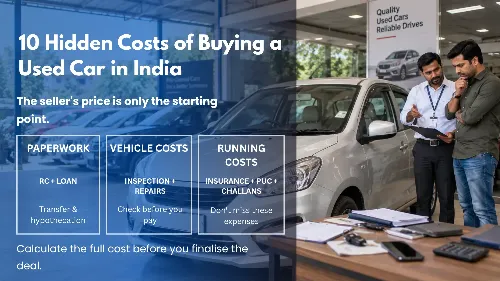
The listing price is rarely the final cost. See the RC transfer, insurance, challan, and repair costs that show up after you buy a used car.
Finding a used car at a good price can feel like a great deal. But the amount you pay the seller is not always the complete cost of getting the car ready for your ownership.
After the purchase, you may still have to deal with RC transfer charges, insurance, pending challans, PUC renewal, inspection costs and repairs. Some parts, such as tyres or the battery, may also be close to replacement when you buy the car.
These expenses do not automatically mean that the car is a bad purchase. The important thing is to know which costs may apply before you finalise the deal. This gives you a more realistic budget and also gives you better information for negotiation.
1. RC Transfer Charges
The seller's asking price is only one part of the transaction. After buying a used car, the ownership records also need to be updated so that the Registration Certificate, or RC, reflects the new owner.
RC transfer can involve government charges, and the applicable amount can vary depending on the state and vehicle. If you use an agent or another service provider, additional service charges may also apply.
You can check the vehicle ownership transfer process and applicable requirements through the official Government of India Parivahan portal.
What to do: Check the required RC transfer process and applicable charges with the relevant RTO before completing the transaction. Do not leave the RC transfer pending after buying the car.
2. Loan or Hypothecation on the RC
A used car may still show a bank or financial institution on the RC if it was previously purchased with a vehicle loan. This is known as hypothecation.
If the previous loan has already been repaid, the hypothecation may still need to be removed through the required process. The official Parivahan HP Termination information explains the relevant process.
The main concern is often not the charge itself but the paperwork. If the loan has not been properly cleared or the required documents are missing, the ownership transfer can become more complicated.
For a wider discussion of problems buyers can face during a used-car purchase, see our used car buying mistakes guide.
3. Pre-Purchase Inspection
A short test drive can tell you how the car feels, but it cannot always reveal every problem. An inspection can help identify issues that may otherwise become your expense after the purchase.
If you are buying privately and cannot inspect the vehicle confidently yourself, you may choose to pay for an independent inspection. The cost depends on the provider, location and type of vehicle.
The purpose of an inspection is not to find a reason to reject every used car. It is to understand the condition of the particular car you are considering before you commit your money.
What to do: If you are uncertain about the vehicle's condition, consider an independent inspection before making the final payment.
If your main concern is accident damage, our guide on how to check an accident car covers that topic separately.
4. Repairs Needed Soon After Purchase
A used car does not have to be poorly maintained to need some work after purchase. A service that is due soon, worn brake components, fluids or other small jobs can become your first ownership expenses.
The actual cost depends on the vehicle's age, model, condition and maintenance history. This is why two cars with similar selling prices can require very different amounts of spending after purchase.
A low purchase price therefore does not always mean a lower overall cost.
What to do: Ask the inspector or mechanic which work is due soon and use that information when deciding the final price.
5. Fresh or Comprehensive Insurance
Insurance is another cost that can be missed when comparing used-car prices. The seller may have a policy that is close to expiry, or the vehicle may no longer have active comprehensive cover.
If you need to arrange fresh insurance, the premium depends on factors such as the vehicle, location, insured value and policy selected.
Do not assume that insurance is automatically included in the price you are paying the seller. Check the current policy document and its validity before completing the deal.
For more information about the financial risks of choosing a very cheap used car, see our cheap used car financial trap guide.
What to do: Ask for the insurance document before paying and include any fresh insurance cost in your purchase budget.
6. Pending Traffic Challans
A pending traffic challan may not appear anywhere in the seller's advertised price. However, an outstanding issue associated with the vehicle can create problems when you are completing the paperwork.
Before buying the car, check its status through the government's official e-Challan portal. You can use the vehicle registration details to check whether any challans are showing.
If an outstanding challan appears, discuss it with the seller before completing the transaction. Do not assume that there is nothing to check simply because the seller has not mentioned any fine.
What to do: Make the challan check part of your normal used-car document checklist.
7. PUC Renewal
The Pollution Under Control, or PUC, certificate is another document you should check before buying a used car. If it has expired, you may need to arrange renewal after taking possession of the vehicle.
The renewal itself may not be a major expense, but the more important point is whether the vehicle can pass the required emission test. If an older vehicle has difficulty passing the test, it may need further attention.
Do not treat an expired PUC as just another small paperwork issue. Check its validity along with the other vehicle documents and understand whether any action is required before or after the purchase.
What to do: Check the PUC certificate and expiry date before completing the purchase. If it has expired, check the current renewal process before taking the car.
8. Tyres Close to Replacement
Tyres are another cost that can be easy to miss. A used car may look completely road-ready while one or more tyres are already getting close to replacement.
Check all four tyres for tread wear, uneven wear, cracks and other visible damage. You should also check the age and overall condition of the tyres instead of judging them only by appearance.
If several tyres are nearing replacement, that is a cost worth considering when deciding whether the seller's price is reasonable.
What to do: Inspect every tyre and include likely replacement costs when comparing the car with other options.
9. A Battery Near Replacement
A weak battery can also become an unexpected expense shortly after buying a used car. The vehicle may start normally during your test drive even when the battery is already getting weak.
This can be harder to judge if the seller has started the car shortly before you arrive. The battery's age and condition can give you a better idea of whether replacement may be approaching.
A battery that is already near the end of its useful life does not necessarily make the car a bad purchase. However, it is a cost you can factor into your negotiation instead of discovering it later.
What to do: If the battery appears old or the car has been unused for some time, ask for its condition to be checked before buying.
10. Small Costs That Add Up
Not every hidden cost is a major repair. Several smaller expenses can appear during the first few weeks of ownership.
Wiper blades, air filters, brake-related consumables, AC work and other small items may need attention depending on the condition of the car.
You do not need to assume that every item will need replacement. The important point is to leave some room in your budget rather than spending every rupee on the purchase price.
What to do: Ask what has recently been replaced and what may need attention soon. Keep a reasonable buffer for small expenses after the purchase.
Where to Check Before Buying
| What to Check | Where to Check |
|---|---|
| RC transfer | Relevant RTO or official Parivahan portal |
| Loan or hypothecation | RC and loan-related documents |
| Vehicle condition | Independent inspection |
| Insurance | Current insurance policy |
| Pending challans | Official e-Challan portal |
| PUC validity | PUC certificate and vehicle records |
| Tyre condition | All four tyres |
| Battery condition | Battery check or inspection |
How to Calculate the Real Used Car Cost
The easiest way to avoid a budget surprise is to look beyond the seller's asking price.
Start with the agreed purchase price. Then add the costs that are likely to apply to that particular vehicle, such as transfer charges, insurance, inspection, PUC renewal, repairs or parts that are close to replacement.
You do not need to assume that every vehicle will have every expense listed in this article. Check each item and work out which costs actually apply to the car you are considering.
This gives you a better way to compare vehicles. A car that costs slightly more but needs fewer immediate expenses may be easier on your budget than a cheaper car that needs several things after purchase.
Frequently Asked Questions
What are the main hidden costs of buying a used car in India?
The main hidden costs can include RC transfer charges, loan or hypothecation paperwork, inspection, insurance, pending challans, PUC renewal, immediate repairs, tyres, battery replacement and smaller items that need attention after purchase.
How do I check pending challans before buying a used car?
Use the government's official e-Challan portal and check the vehicle using its registration details. If an outstanding challan appears, discuss it with the seller before completing the purchase.
Is RC transfer necessary after buying a used car?
Yes. The vehicle records need to be updated after ownership changes. Check the required transfer process and documents with the relevant RTO or through the official Parivahan portal before completing the purchase.
Should I check insurance before buying a used car?
Yes. Check the current insurance document and its validity before paying the seller. If you need fresh or comprehensive cover, include that cost in your purchase budget.
How much extra money should I keep for hidden costs?
There is no single amount that applies to every used car. The cost depends on the vehicle's age, condition, insurance status, paperwork and parts that may need replacement. Use the Car Ownership Cost Calculator to build a more realistic estimate for the vehicle you are considering.
Do Not Look Only at the Used Car Price
The advertised price is only the starting point when buying a used car. The real cost becomes clearer after you check the paperwork, insurance, challans and condition of the vehicle.
The good part is that most of these potential costs can be checked before completing the deal. Check the RC, confirm the loan status, verify the insurance and PUC, search for challans and inspect the vehicle properly.
If you find an expense that is likely to come up soon, you can use that information during negotiation. That is much better than discovering the same cost after the car is already yours.
Before finalising your budget, use the Car Ownership Cost Calculator and Used Car Budget Calculator. If you are planning to finance the purchase, the Car Loan Calculator can also help you understand the financing side.
After the purchase, you will also have regular running and maintenance expenses. For that separate topic, see our used car maintenance cost guide.