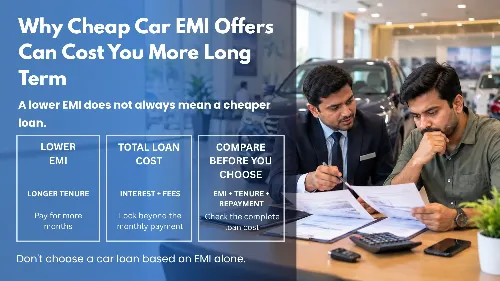
A low car EMI does not always mean a cheap loan. See how tenure, interest rates, and extra fees can increase the total cost of your car loan.
A car loan can look cheap when you see a low monthly EMI in an advertisement. The EMI may fit your monthly budget, but that does not mean the loan is cheap.
In many cases, a lower EMI comes from a longer loan tenure. You pay less every month, but you keep paying for more months. This can increase the total interest you pay over the life of the loan.
The interest rate is also important, but it is not the only thing you should compare. The loan amount, tenure, fees and repayment terms can all change the final cost of your car loan.
Check Your Own Numbers: Use our free, zero-signup Car Affordability Calculator to check your EMI, total interest and repayment for different loan amounts and tenures. You can also use our Loan Eligibility Checker to understand your possible borrowing eligibility.
How Much Can a Longer Car Loan Tenure Add?
Before you choose a longer tenure just to bring down the EMI, check how much extra interest you may pay.
SBI currently lists its new-car loan rates from 8.70% to 9.85% p.a. on its official Auto Loans interest rate page. The rate you actually receive can depend on the applicable pricing and your borrower details.
Take an example of a ₹6 lakh car loan at 8.70%. Here is what happens when the repayment period changes:
| Tenure | Monthly EMI | Total Interest | Extra Interest vs 48 Months |
|---|---|---|---|
| 48 months | ₹14,846 | ₹1,12,594 | Baseline |
| 60 months | ₹12,368 | ₹1,42,070 | +₹29,476 |
| 84 months | ₹9,562 | ₹2,03,237 | +₹90,643 |
These are FinTool Baba calculations using the published 8.70% starting rate and an example ₹6 lakh loan. They are for explanation only and are not a guaranteed loan offer.
Look at the difference. The 84-month option brings the EMI down to ₹9,562, which is about ₹5,284 lower than the 48-month EMI. But you pay about ₹90,643 more in calculated interest.
Your own numbers will be different depending on the amount you borrow, the rate offered to you and the tenure you choose. Before accepting the loan, run the exact figures through our Car Affordability Calculator.
Is a 0% Car Loan Really Cheaper?
A 0% interest car loan sounds like the best deal because you are not paying the usual loan interest. But do not decide only from the 0% shown in the offer.
Sometimes the finance offer can come with a lower cash discount on the car. This means the difference between the cash price and the finance price can affect what you actually spend.
The cheapest-looking EMI or interest rate is not always the cheapest deal. Check the full amount you will pay for the car and the loan together.
Do Processing Fees and Add-Ons Increase the Cost?
Yes, they can. The EMI shown in an advertisement may not tell you every cost connected with the loan.
Processing and documentation charges may apply. SBI also publishes processing-fee information separately for its auto-loan schemes, so check the applicable charges before accepting the loan.
Add-ons can also increase your borrowing cost. For example, if an insurance premium or another charge is added to your loan principal, you may end up paying interest on that financed amount as well.
Could a Different Loan Rate Change Your Total Cost?
When you compare loans, do not look at the interest rate alone. A loan with a slightly higher rate can sometimes have a lower total cost if you borrow less or repay it over a shorter period.
SBI's official Real-Time Xpress Credit page currently shows a starting rate of 10.00% p.a. in its interest-rate section. The page also states that the product is designed for eligible salary-package account customers, with loan amounts up to ₹50 lakh and tenure of 6 to 84 months.
The 10.00% rate is a starting figure shown by SBI and does not mean every borrower receives 10.00%. Before comparing this option with a car loan, check the rate actually offered to you, eligibility, fees and repayment terms.
If you are considering using a personal loan to buy a car, compare the full cost of both loans. A lower or similar-looking rate does not by itself tell you which option will cost less.
New vs Used Car: Do Not Compare the Rate Alone
A used-car loan can have a higher interest rate than a new-car loan. But you may also borrow a much smaller amount for the used car. That is why the interest rate alone cannot tell you which option will cost less.
SBI's official Auto Loans page lists its Certified Pre-owned Car Loan Scheme at 10.45% to 15.60% p.a., while its new-car loan range starts at 8.70% p.a.
For example, look at these loan calculations:
| Option | Loan Amount | Rate | Tenure | Total Outflow |
|---|---|---|---|---|
| New car | ₹6.4 lakh | 8.70% | 60 months | ₹9,51,541 |
| Used car (lower rate) | ₹4 lakh | 10.45% | 48 months | ₹5,91,121 |
| Used car (higher rate) | ₹4 lakh | 15.60% | 48 months | ₹6,40,208 |
These are example calculations based on the stated loan amounts, rates and tenures. They simply show why you should look at the complete loan cost instead of comparing interest rates alone.
Planning to Close the Car Loan Early?
If you expect to make a large payment later or close the loan early, check the pre-payment terms before you take the loan.
For the example ₹6 lakh loan at 8.70% for 48 months, the calculated outstanding balance after 24 months is about ₹3,25,941. If a 5% charge were used only as an example, it would be about ₹16,297 on that balance.
The 5% figure here is only an example to explain the calculation. It is not a claim that your lender will charge 5%.
The RBI's Pre-payment Charges on Loans Directions, 2025 apply to loans and advances sanctioned or renewed on or after 1 January 2026. For floating-rate loans granted to individuals for purposes other than business, the directions say regulated entities shall not levy pre-payment charges. Fixed-rate loans and other cases can have different treatment under the applicable rules.
Flat Rate vs Reducing Balance: Why the Percentage Can Mislead You
Two car-loan offers can show the same percentage but still have very different costs if the interest is calculated differently.
With a flat rate, interest is calculated using the original loan amount. With a reducing-balance method, interest is calculated on the outstanding principal as you repay the loan.
Take a simple example of a ₹5 lakh loan for four years at 5.5%. At a flat rate, the total interest would be ₹1,10,000. At a 5.5% reducing-balance rate for the same amount and period, the calculated interest would be about ₹58,155.
This example is only to explain the difference between the two methods. It is not a rate offered by a particular lender.
Frequently Asked Questions
Why can a lower car EMI cost more?
A lower EMI can come from a longer loan tenure. You pay less each month, but you make payments for more months and may pay more total interest. In the ₹6 lakh example, the 84-month option adds about ₹90,643 in calculated interest compared with 48 months.
Does a 0% car loan always mean it is the cheapest option?
No. Check the cash price, finance price, down payment, fees and total repayments. A finance offer may have a smaller cash discount, which can change the overall cost.
Can a higher interest rate loan cost less?
Yes. The loan amount and tenure also affect the total cost. A smaller loan or shorter repayment period can sometimes result in lower total interest even when the interest rate is higher.
Is the 10% personal loan rate available to everyone?
No. The 10.00% p.a. figure shown on SBI's Real-Time Xpress Credit page is a starting rate, not a guaranteed rate for every borrower. Check your eligibility and the actual rate offered to you.
Can I avoid car loan pre-closure charges?
It depends on the type of loan and the applicable rules. The RBI directions cover specified floating-rate loans for individuals taking loans for non-business purposes when the loan is sanctioned or renewed on or after 1 January 2026. Check your loan documents before assuming a charge does not apply.
What is the difference between flat-rate and reducing-balance interest?
A flat rate uses the original loan amount for its interest calculation, while reducing-balance interest is calculated on the outstanding principal. Therefore, the two percentages should not be compared without checking the total interest and repayment.
Compare the Total Cost Before You Choose
A low car EMI can make a loan feel comfortable, but the monthly payment is only one part of the decision.
Before you sign the loan agreement, check how much you will borrow, how long you will repay it, how much interest you will pay and what extra charges apply.
Do not choose a car loan only because its EMI is lower. A slightly higher EMI over a shorter period can sometimes save you a significant amount of interest.
Enter your own loan amount, interest rate and tenure in the Car Affordability Calculator and compare the result before accepting an offer. You can also check your borrowing eligibility with the Loan Eligibility Checker and estimate your wider car expenses using the Car Ownership Cost Calculator.
If you are trying to decide how much EMI may be comfortable for your income, you can also read our car EMI affordability guide.