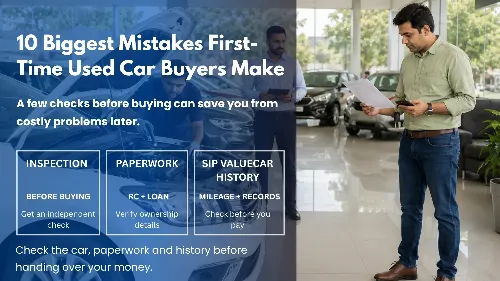
Thinking of buying a used car in India? Avoid these 10 mistakes around inspection, loans, paint, odometers, and RC transfer that cost buyers most.
Buying your first used car can be exciting. You find a model you like, the price looks better than a new car, and the seller seems genuine. After a short test drive, it is easy to think, “This looks good. Let's complete the deal.”
That is where many first-time buyers go wrong.
A used car can look clean and still have mechanical, paperwork or ownership issues that are not obvious at first. The good news is that many of these problems can be checked before you pay.
The 10 Mistakes That Cost Buyers the Most
You do not need to be a car expert to avoid these mistakes. You simply need to know what to check before making the payment.
1. Skipping a Pre-Purchase Inspection Because the Seller Seems Trustworthy
A friendly seller and a clean-looking car can make an inspection feel unnecessary. But a short viewing cannot tell you everything about the vehicle's mechanical condition.
An independent mechanic can identify problems that may not be obvious during a normal test drive. More importantly, the inspection gives you information that does not depend only on the seller's description.
What to do instead: Get the car inspected before finalising the deal. If the seller refuses a reasonable inspection, think twice before proceeding.
2. Not Reading the RC for Loans Still Attached to the Car
Do not check the Registration Certificate only for the owner's name. Look for the hypothecation details as well.
If a lender's name is still listed, the car may have a loan attached to it. The seller needs to complete the required loan-closure and hypothecation-removal process before the ownership transfer can move forward properly.
The source material notes that a bank NOC may take around two to three weeks after the loan is closed. That can delay your purchase if the seller has not started the process.
What to do instead: Check the hypothecation entry before agreeing to the final price. If a lender is listed, ask for the required NOC and loan-clearance documents.
3. Assuming Fresh Paint Means the Car Was Never in an Accident
Fresh paint can make an older car look much better, but it does not prove that the vehicle has never been damaged. A repainted panel may simply be cosmetic, or it may have been repaired after an accident.
Instead of repeating the complete inspection process here, use our accident history inspection guide for the detailed checks.
You can also check available insurance claim information through the Insurance Information Bureau's V-Seva portal.
4. Judging the Car on a Short, Easy Test Drive
A five-minute drive on a smooth road may make the car feel perfectly fine. But it may not reveal suspension noise, steering issues, vibrations or braking problems.
What to do instead: Where safe and practical, drive over different road surfaces. Test the brakes, listen for unusual sounds and check whether the steering feels stable. If possible, include a higher-speed road as part of the test drive.
5. Never Checking the Chassis Number on the Vehicle
The chassis number is an important vehicle identifier. Yet many buyers never compare the number physically stamped on the car with the number shown on the documents.
A mismatch should not be treated as a simple paperwork error. It can indicate a serious problem with the vehicle's identity or ownership.
What to do instead: Locate the chassis number on the vehicle and compare it character by character with the RC and insurance documents before making the payment.
6. Choosing a Car Purely Because It's the Cheapest Listing
The cheapest used car can look like the best deal, but the lowest asking price does not always mean the lowest overall cost.
A cheaper car may have poor service records, more wear or other problems that have not been reflected properly in the asking price.
Our guide on why cheap used cars can become expensive covers this financial trap in more detail.
What to do instead: Compare cars with similar age, mileage, condition and service history. Do not choose purely because one listing has the lowest price.
7. Paying the Agreed Price Even After the Inspection Finds Problems
Getting an inspection is only half the job. You also need to use what the mechanic finds.
If the inspection identifies genuine repairs or maintenance issues, those findings should become part of the final price discussion. Otherwise, you may end up paying the full agreed price and handling those costs yourself.
What to do instead: Treat inspection findings as negotiation points, not information to ignore.
8. Skipping the Encumbrance and Ownership Check
Checking the RC is important, but do not assume it answers every question about the vehicle's current legal position.
Pending ownership or other vehicle-related issues can create problems after you have already paid. Before making the final payment, check the vehicle's current details through the official VAHAN portal using the registration number.
What to do instead: Make legal and ownership verification part of your normal buying process instead of relying only on the seller's word.
9. Handing Over Full Payment Before the RC Transfer Starts
Once the full amount is paid, the buyer may feel that the deal is finished. But ownership transfer still needs to happen, and the timeline can vary depending on the state and RTO.
If the seller becomes difficult to contact after receiving the full payment, you may have less leverage during the transfer process.
What to do instead: Use a clear sale agreement, keep payment records and make sure the ownership-transfer process has been properly initiated.
10. Taking the Odometer Reading at Face Value
A car showing 45,000 km can look much more attractive than one showing 85,000 km. That is why the dashboard reading should not be your only evidence of mileage.
Odometer rollback is illegal, but buyers should still look for inconsistencies. For example, very low displayed mileage combined with heavy wear on the pedals, steering wheel or driver's seat deserves closer attention.
What to do instead: Compare the odometer with service records, service stickers and the physical condition of the car. If the numbers do not make sense together, investigate further.
All 10 Mistakes at a Glance
| No. | Mistake | What's Really at Stake |
|---|---|---|
| 1 | No pre-purchase inspection | Unexpected mechanical problems after purchase |
| 2 | Not checking RC for loans | Loan-clearance problems and transfer delays |
| 3 | Trusting refurbished paint | Previous accident or repair issues being missed |
| 4 | Skipping a proper test drive | Mechanical faults appearing after purchase |
| 5 | Not verifying chassis number | Potentially serious vehicle-identity problems |
| 6 | Buying the cheapest listing | Repair costs removing the initial saving |
| 7 | Ignoring inspection findings | Paying for known problems yourself |
| 8 | Skipping ownership checks | Legal and ownership-related complications |
| 9 | Paying the full price too early | Less leverage during the transfer process |
| 10 | Ignoring possible odometer rollback | Paying based on unreliable mileage |
Frequently Asked Questions
What's the single most common mistake used car buyers make in India?
Skipping the pre-purchase inspection is one of the biggest mistakes. A car may look clean and the seller may seem genuine, but neither tells you everything about its mechanical condition.
How do I find out if a used car still has a loan against it?
Check the hypothecation details on the RC. If a lender's name is listed, the loan may not have been fully cleared. You can also check the vehicle through the official VAHAN portal.
What's a reliable way to spot a tampered odometer?
Compare the displayed mileage with service records, service stickers and physical wear inside the car. A very low reading combined with heavy wear deserves further investigation.
Should the full payment happen before or after the RC transfer?
Do not treat full payment as the end of the process when the ownership transfer has not been properly initiated. Use a clear agreement, keep payment records and make sure the seller remains cooperative until the transfer is completed.
Check Before You Pay
You do not need to spend hours inspecting every used car you see. But before buying the one you actually want, take a little extra time to verify it.
Get an independent inspection, read the RC, check the chassis number, take a proper test drive, review the service history and verify the ownership details. Then use what you find to negotiate the final price.
Also check whether the car fits your overall budget. Use our Car Ownership Cost Calculator to understand the ownership cost and the Used Car Budget Calculator to check your spending limit.
If you plan to finance the purchase, the Loan Eligibility Checker can help you understand your likely borrowing capacity. For the broader question of how much you should spend, our used car budget guide goes deeper.